
eSIM India data plans compared by price, GB, and network — practical picks for leisure and business travelers before you land at IGI or CSIA.
Verizon TravelPass runs $10 a day in India. AT&T's International Day Pass costs the same. Burn through a two-week Mumbai-to-Rajasthan itinerary and you've handed your carrier $140 before a single rupee hits your wallet — for throttled speeds and a data bucket that resets every 24 hours whether you used it or not.
The arithmetic only gets worse on longer trips. A month of TravelPass in India totals $300, and that figure assumes you never exceed the daily allotment; go over and the carrier drops you to 2G speeds that won't load Google Maps at Jaipur's old city gates. Roamfly's India eSIM offers 20 GB for 30 days at a fraction of that — no daily resets, no throttle cliff at 11 PM.
The gap between what home carriers charge and what a local-rate eSIM costs is the entire reason esim india data plans for travelers exist as a category. Your phone is already capable; your carrier is just the expensive middleman (Verizon TravelPass international pricing).

India's three main networks and where they actually reach
Jio blankets roughly 99% of India's census towns with 4G — Airtel sits close behind at 97%, while Vi (formerly Vodafone Idea) has quietly contracted to strong coverage in metros and weak-to-absent signal across large stretches of rural Rajasthan and Odisha. (TRAI Telecom Subscription Data Report 2024) The gap matters the moment you leave a highway.
On the Delhi–Agra corridor, all three carriers maintain solid LTE along NH19. The Mumbai–Goa coastal route is different: Vi drops out near Ratnagiri for stretches that run 30–40 km, while Jio and Airtel hold 4G through most of it. Median 4G download speeds tell the same story — Airtel leads at 23.4 Mbps, Jio follows at 21.1 Mbps, Vi trails at 12.8 Mbps (Ookla Speedtest India 2024 operator breakdown).
Practical rule: If your itinerary includes Himachal Pradesh hill towns, Spiti Valley, or the Rann of Kutch, pick Airtel or Jio. Vi's rural rollout has stalled since its 2023 financial restructuring, and you'll find dead zones where the other two still show two bars.
Most Roamfly India plans route through Airtel or Jio host networks, which covers the bases for nearly every traveler route.
Practical rule: If your route includes anything beyond Delhi, Mumbai, or Bengaluru — a Rajasthan circuit, the Konkan coastal road, or the Manali highway — choose an Airtel-backed plan over Jio. Airtel's rural 4G footprint runs roughly 15% wider outside Tier-1 cities, and dead zones on the Delhi–Jaisalmer corridor punish Jio users disproportionately.
eSIM India data plans compared: GB, validity, and price
Three gigabytes lasts about four days of Google Maps, Instagram, and WhatsApp calls in Mumbai — which is why the 7-day tier disappears fast on longer trips.
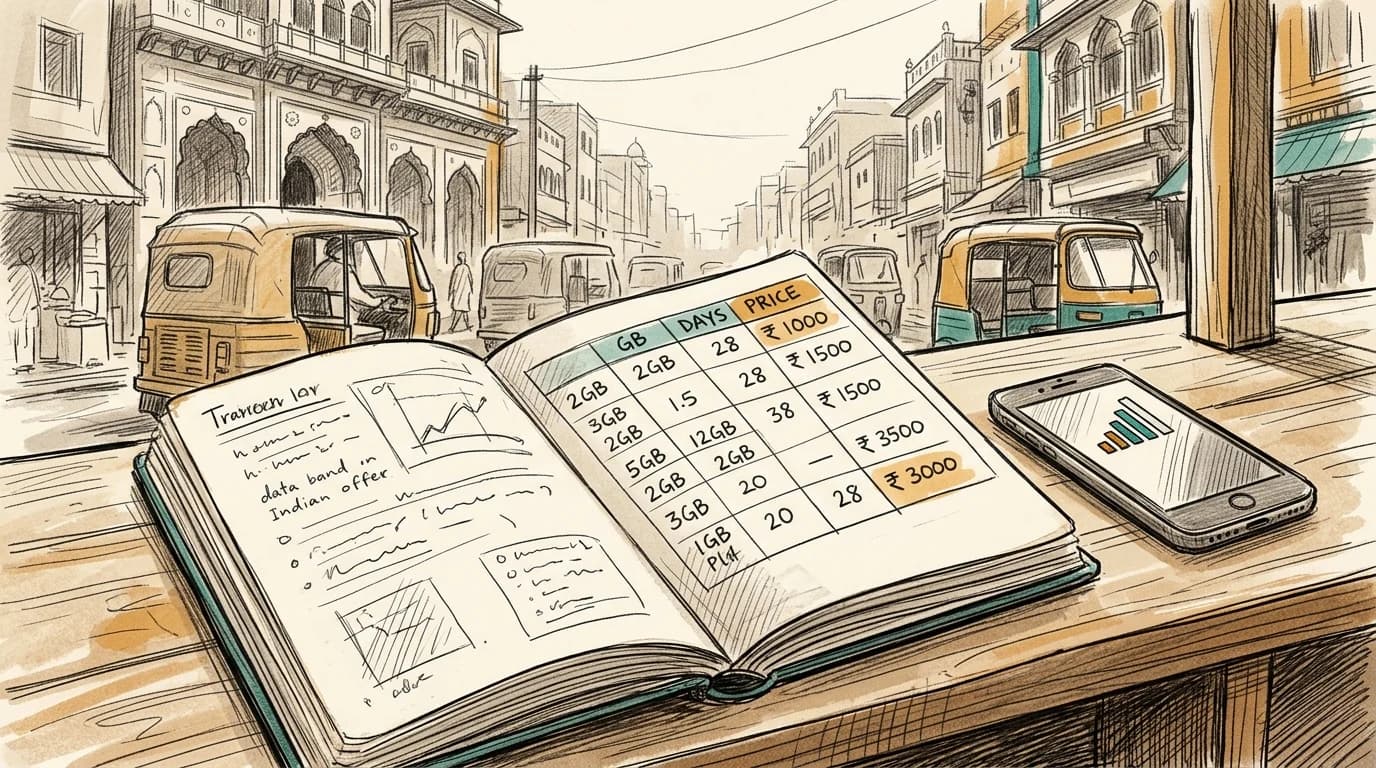
Roamfly's India lineup runs from a 3 GB / 7-day entry point up to 20 GB across 30 days at $188.50, which works out to roughly $9.43 per GB. That per-GB rate is the number worth tracking: shorter plans carry a premium because carriers price urgency, not data volume. A two-week Rajasthan circuit — Jaipur to Jodhpur to Udaipur — burns through 3 GB before you've finished the first leg if you're using navigation and sharing reels.
| Plan | Validity | Price | Per-GB cost |
|---|---|---|---|
| 3 GB | 7 days | high | |
| 20 GB | 30 days | $188.50 | ~$9.43 |
The 20 GB / 30-day tier makes sense for anyone combining metro cities with slower-internet rural stretches, where you'll stream downloaded content offline but still need data for payments and maps. Check the full tier breakdown on Roamfly's India eSIM before committing to a shorter plan you'll outgrow by day three.
Before you land in India
- Confirm your phone supports eSIM and is carrier-unlocked
- Buy your plan on home Wi-Fi before departure
- Download the eSIM profile while still at home
- Keep the eSIM toggled off until you clear customs
- Set the Roamfly eSIM as your default data line on arrival
Practical rule: For trips of 15 days or fewer, the 5 GB Standard plan at $1.80/GB beats stacking two Starter plans. The math flips only if you need offline maps for rural areas — in that case, download them on hotel Wi-Fi and the 3 GB Starter covers most urban itineraries.
How to install your eSIM before landing at IGI or CSIA
Purchase confirmed, QR code in your inbox — that's the easy part. Installing correctly before you clear customs at Indira Gandhi International or Chhatrapati Shivaji Maharaj International saves you the chaos of hunting for a tray table or a signal-dead arrivals hall.
iPhone: Open Settings > Mobile Data > Add eSIM > Use QR Code. Scan the code from your confirmation email. iOS activates the profile immediately; you don't need a live connection because the download happens over Wi-Fi before you board.
Android (Pixel / Samsung): Settings > Network & Internet > SIMs > Add eSIM, then scan. The flow varies slightly by manufacturer, but the QR scan step is identical. Full step-by-step screenshots are in the eSIM activation guide for iPhone.
India requires every SIM — physical or embedded — to be registered to a traveler identity. Roamfly handles that registration on the backend at purchase; you don't file paperwork at the airport (Apple Support, Use an eSIM on iPhone).
Practical rule: Activate the moment you land, before clearing customs. The registration handshake with the Indian carrier completes faster when the device is inside the country.
Set your home SIM to data roaming off. One toggle prevents surprise charges the second you step off the jet bridge.
eSIM vs roaming for India trips
| Factor | Roamfly eSIM | Home Carrier Roaming |
|---|---|---|
| Setup time | 2 minutes, before you fly | setup, auto-connects |
| Typical daily cost | Flat plan rate | £5–£15 per day |
| Keeps your number | (dual-SIM) | |
| Coverage fallback control | (manual network select) | |
| Top-ups | In-app, instant | Call carrier or use app |
Business traveler vs leisure traveler: which plan fits
A conference at Bengaluru's Bhartiya City campus hits differently than three weeks drifting Delhi–Agra–Jaipur. The data demands are almost opposite.
Business travelers should prioritize hotspot headroom. You'll be tethering a laptop through back-to-back calls at the Hilton Bengaluru or the Leela Chennai, and 20 GB evaporates faster than it sounds once Teams video enters the picture. Look for plans with no hotspot restrictions and at least 30-day validity to cover the full trip window — conference prep, the event itself, and the debrief flight home. If India is one stop on a multi-country itinerary, the worldwide business eSIM guide maps out how to stack or replace plans across corridors like Bengaluru–Singapore–Dubai.
Leisure travelers on the Golden Triangle rarely need that much data. Navigation, Instagram uploads at the Taj Mahal, and the odd voice call over WhatsApp tops out around 8–10 GB for a two-week trip.
Match validity to your exact departure date. A 30-day plan bought four days before you land wastes four days of coverage you paid for.
Pick the tier that matches your actual use case, not the largest plan available.

Get connected before you leave
Roamfly's India eSIM takes under five minutes to activate — no post office queue at Indira Gandhi, no arguing with a counter agent at CSIA who's already seen 400 passengers that shift. You scan a QR code, confirm the APN, and your phone locks onto Airtel or Jio before the seat-belt sign turns off.
Plans start well below what your home carrier charges per roaming day. A 20 GB / 30-day package covers a month of maps, UPI payment QR scans, and enough buffer for a video call back home without throttling anxiety.
Practical rule: Buy before departure, not at the airport. Activation requires a stable Wi-Fi connection, and the arrivals hall at Terminal 3 gets congested enough that your hotel lobby is a calmer fallback — but that costs you 45 minutes you didn't budget.
Roamfly's India eSIM lists every current package with live pricing. Pick your GB, check out, and the QR code lands in your inbox.
Related guides
Ready to get connected? Roamfly's travelers eSIM ships in under 5 minutes.
Frequently asked questions
Does my iPhone or Android phone support eSIM in India?
iPhones from XR (2018) onward, every Google Pixel from 4 onward, and Samsung Galaxy S21+ flagships all support eSIM. Verify on iPhone via Settings → General → About → Available SIM; on Android, Settings → Connections → SIM Manager. Phones purchased in mainland China are the main exception — they typically ship without eSIM hardware.
Do I need to register my eSIM with Indian authorities before using it?
Traveler eSIMs sold through international providers like Roamfly operate on roaming agreements with Indian host MNOs and do not require TRAI-mandated local SIM registration. (TRAI SIM registration and subscriber verification regulations) Local Indian SIMs do require Aadhaar-linked registration — that rule does not apply to foreign visitor eSIM plans.
Will an India eSIM work in rural Rajasthan or on the Mumbai local rail network?
On the Mumbai suburban rail network, Jio and Airtel maintain consistent 4G coverage across all 11 lines. Rural Rajasthan is patchier — Jio reaches roughly 97% of India's 650,000 villages by tower count (TRAI Telecom Subscription Report), but signal in desert stretches between Jaisalmer and Sam can drop to 2G or dead zones.
Can I use my India eSIM as a mobile hotspot?
Most Roamfly India plans permit hotspot tethering — check the plan detail page before purchasing, as a small number of high-data budget tiers restrict it. Enable it on iPhone via Settings → Personal Hotspot; on Android via Settings → Network → Hotspot. Hotspot data draws from the same pool as direct device data.
What happens if I run out of data before my India trip ends?
Top up through the Roamfly app — credit applies within 60 seconds and extends validity if your original plan is still active. There is no need to scan a new QR code or reinstall the eSIM profile. If the plan has already expired, purchasing a new package and scanning a fresh QR is the faster path.