
Compare eSIM India prepaid data plans for travelers: coverage, cost, and which plan fits your trip — from a 5-day Delhi visit to a 30-day circuit.
AT&T's International Day Pass runs $12 per day in India (AT&T International Day Pass pricing page) — that's $84 for a week before you've opened Google Maps once. Verizon's TravelPass charges the same rate (Verizon TravelPass pricing page). On either plan, you're paying for access to your existing data bucket, not unlimited usage, so a single afternoon of navigation in Jaipur's Old City can burn through your daily allotment.
A prepaid eSIM flips the math entirely. A 20 GB / 30-day package through Roamfly lands around $8–15 depending on the network tier — a fraction of what the day-pass math produces over any trip longer than three nights. India's local networks, Jio and Airtel in particular, deliver median LTE download speeds above 30 Mbps on major corridors (Ookla Speedtest Global Index India 2025), so you're not trading coverage for savings.
The hidden cost is inconvenience, too. Day passes expire at midnight local time, not 24 hours from activation, meaning a late flight into Chhatrapati Shivaji Maharaj International can burn a full day's charge before you reach the taxi stand. Prepaid eSIM validity runs from activation — your clock, your rules.

India's three major networks and what they mean for your eSIM
Jio connects 482 million subscribers — the largest base in India — and that scale shows in coverage: 4G reaches 99% of India's census towns, and 5G now blankets Delhi, Mumbai, Bengaluru, and Hyderabad's urban cores (TRAI Telecom Subscription Data Q1 2025). Airtel runs a slightly thinner footprint but consistently scores higher on urban 5G speeds. Vi, once Vodafone India, is third and contracting — adequate in Kolkata and Pune, patchy once you leave state capitals.
The gaps matter most in three places: the Thar Desert towns of Rajasthan beyond Jaisalmer, the Northeast states like Meghalaya and Nagaland, and Ladakh above Leh. Jio and Airtel both extend into these zones, but expect 2G fallback on remote mountain roads, not 4G streaming.
Practical rule: If your itinerary includes Spiti Valley, Tawang, or any Rajasthan border district, pick a Jio-hosted plan. Its rural tower density is unmatched, and Airtel is a distant second in those corridors.
For a city-only circuit — Delhi to Agra to Varanasi — any major host network handles it. The how eSIM activation works on iPhone and Android guide walks through the QR scan before you board.
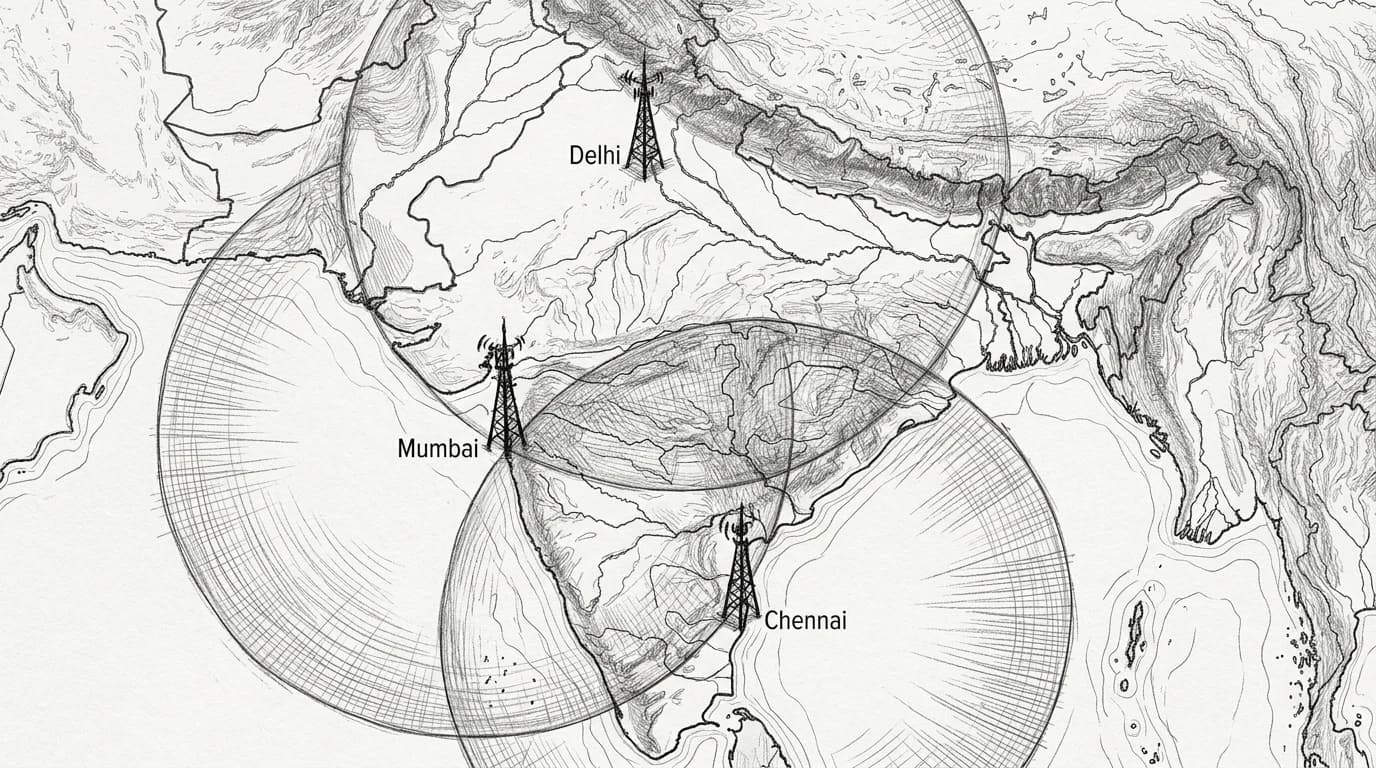
Practical rule: If your itinerary stays inside Delhi, Mumbai, Bengaluru, or Chennai, any of the three major networks will hold a solid 4G signal. The operator choice only matters once you head into Rajasthan's desert towns, the Northeast states, or Ladakh — and there, Airtel wins.
Prepaid eSIM plan options for India: data, validity, and price compared
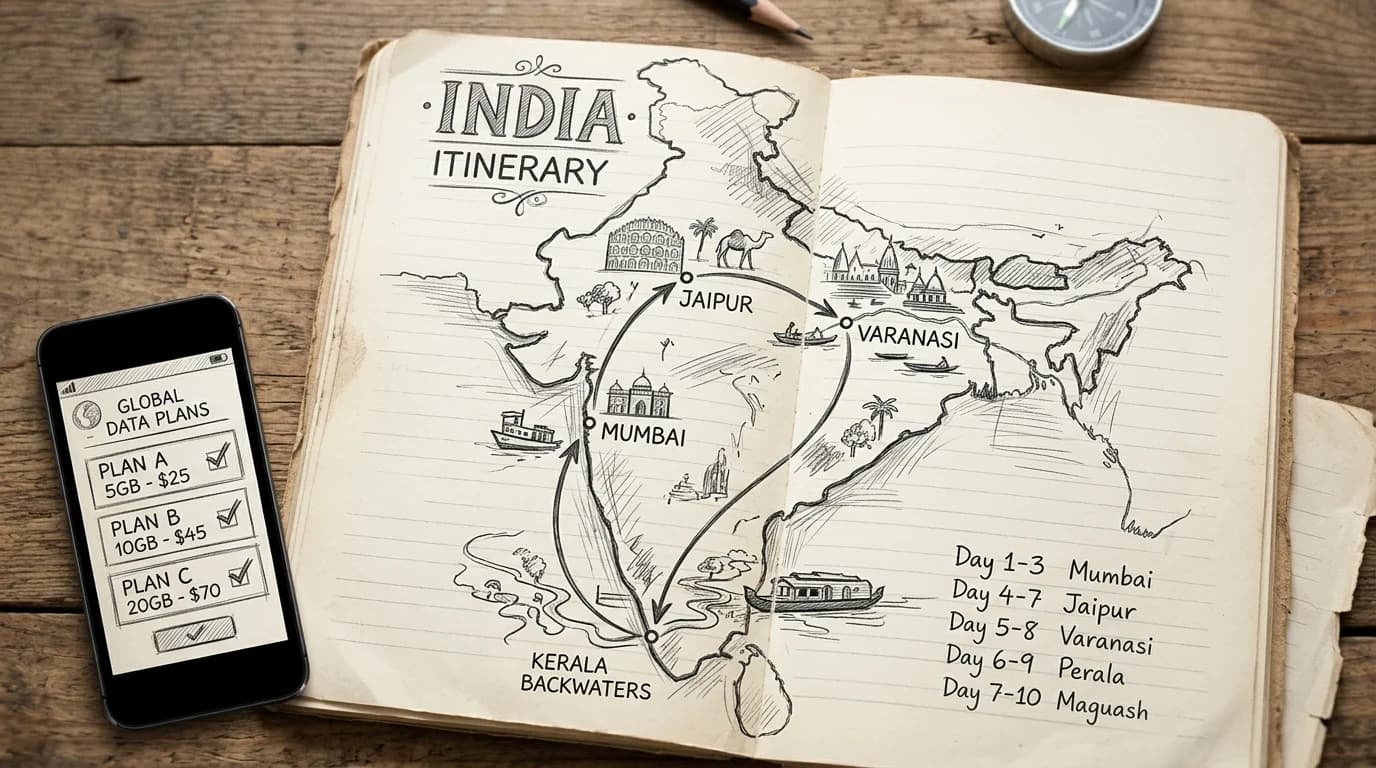
Three tiers cover most India trips. A 5–7 day sprint through Delhi and Agra rarely needs more than 5 GB; a 15-day Golden Triangle plus Rajasthan loop eats closer to 10–12 GB if you're streaming maps and uploading reels; a full 30-day circuit — Mumbai to Kerala to Varanasi — justifies topping out at 20 GB to avoid mid-trip top-ups.
Roamfly's India catalog runs from roughly $8–$12 for short-stay 5 GB / 7-day packages up to $28–$35 for 20 GB / 30-day plans, with mid-range 10 GB / 15-day options sitting around $16–$22. Those figures already undercut most home-carrier international add-ons, which routinely charge $10 per day for throttled speeds. Data is delivered over Jio or Airtel's 4G LTE grid, which blankets every major city and most NH highways.
Validity matters as much as gigabytes. A 7-day plan activated on arrival in Mumbai expires before you reach Goa if you burn three days on trains — buy one day of buffer or step up to the 15-day tier.
Roaming vs eSIM for India travel
| Factor | Home carrier roaming | Roamfly India eSIM |
|---|---|---|
| Daily cost | Often $10–$15 per day | Fixed prepaid rate |
| Setup | Automatic, no action | 2 minutes, before you fly |
| Network choice | (carrier decides) | (Airtel or Jio) |
| Keeps your number | (dual-SIM) | |
| Runs out unexpectedly | (bill shock) | (prepaid cap) |
Which plan fits your India itinerary
Three trips, three very different answers. A 10-day Golden Triangle run — Delhi, Agra, Jaipur — burns through maybe 8–10 GB if you're navigating heavily and sending photos home. A 5 GB or 10 GB short-validity plan covers that without paying for days you won't use.
Four weeks backpacking Rajasthan into Kerala is a different calculation. You'll cross patchy rural coverage between Jodhpur and Jaisalmer, stream music through overnight trains, and rely on Google Maps in cities where addresses are suggestions. A 20 GB / 30-day plan is the floor, not the ceiling.
Practical rule: If your trip runs longer than 21 days, buy validity first and data second — a 30-day plan that expires on day 22 costs you a second purchase and a gap in coverage at the worst moment.
Business travel to Bengaluru sits in its own bracket. Roamfly's guide to eSIM for business travelers covers hotspot-heavy use cases, but the short answer is: budget 1–2 GB per workday minimum if you're tethering a laptop through client meetings.
Before you land in India
- Confirm your phone is unlocked and eSIM-capable
- Buy your plan on home Wi-Fi before departure
- Download the eSIM profile and save the QR
- Toggle the eSIM off during the flight
- Activate on arrival — before clearing customs
- Set the India eSIM as your default data line
Practical rule: Match plan validity to your last full day in-country, not your flight home. A 15-day plan activated on arrival expires before a 16-day itinerary ends — and buying a second plan for one leftover day costs more than upgrading to 30 days upfront.
Get connected before you land in Delhi or Mumbai
Ready to get connected? Roamfly's India eSIM ships in under 5 minutes.
Activation takes about 90 seconds once your QR code arrives — which means you can finish the process on the tarmac at Chhatrapati Shivaji Maharaj International or Indira Gandhi International before the seatbelt sign even switches off. That gap between wheels-down and the immigration queue is exactly when you want Maps, WhatsApp, and your hotel confirmation already loading.
The plans covered in this guide range from lightweight tourist data to multi-week buffers sized for remote work. Pick the GB tier that matches your itinerary length, install the eSIM profile before departure, and toggle it on the moment you land.
Practical rule: Activate your India eSIM before clearing customs. The arrivals hall at Terminal 3 in Delhi has patchy Wi-Fi — don't rely on it to complete installation while a queue builds behind you.
Related guides
Ready to get connected? Roamfly's travelers eSIM ships in under 5 minutes.
Frequently asked questions
Which iPhones and Android phones support eSIM in India?
Every iPhone from XR (2018) onward supports eSIM, as do Google Pixel 4 and later, Samsung Galaxy S20+ flagships, and most OnePlus 11+ models. Confirm on iPhone via Settings → General → About → Available SIM; on Android via Settings → Connections → SIM Manager. Phones bought locked to a single carrier may block eSIM installs regardless of hardware.
Can I activate my India eSIM before boarding my flight?
Yes — install the eSIM profile at home over Wi-Fi, then leave it on standby. The plan does not start counting data or validity until the eSIM registers on an Indian host network (Airtel, Jio, or Vi) after you disable airplane mode on arrival. Activating in advance cuts setup time at the airport to under 60 seconds.
Does an India eSIM work in Ladakh or the Northeast states?
Coverage is patchy in both regions. Airtel-routed plans perform best in Ladakh along the Leh–Manali highway and in Srinagar. The Northeast — Arunachal Pradesh, Mizoram, Nagaland — has BSNL dominance, and most traveler eSIMs do not roam onto BSNL infrastructure. Expect offline gaps outside district headquarters in those states.
Can I use my India eSIM as a hotspot for my laptop?
Hotspot (personal hotspot or tethering) is supported on Airtel and Jio-backed eSIM plans. There is no separate tethering fee — data drawn by connected devices counts against the same pool as your phone. A 10 GB plan shared with a laptop will drain noticeably faster; size up to at least 20 GB for trips where you need laptop connectivity daily.
What happens when I run out of data in India — can I top up without buying a new plan?
Top-ups are available through the Roamfly app and apply within about 60 seconds, provided your current plan has not expired. If the validity window has already closed, you need to purchase a new plan and install a fresh profile. Check your remaining balance in the app before the last day of validity to avoid the reinstall step.