eSIM vs local SIM card — a straight comparison of cost, convenience, coverage, and when each option actually wins. Real numbers, no fluff.
# eSIM vs Local SIM Card: Which Is Better for Your Trip
The counter at Suvarnabhumi's arrivals hall has a queue that moves like airport security on a public holiday. Forty minutes. That's how long it took a traveler ahead of me to buy a 30-day SIM from the AIS booth — passport check, form, test call, receipt, SIM tray hunt — while a connecting flight to Chiang Mai ticked closer on the departures board. The SIM cost 600 baht, roughly $18. The opportunity cost was a cab ride taken at a dead sprint.
That moment is the honest frame for this comparison. Neither option is obviously superior. A local SIM bought at a Bangkok street stall is sometimes the cheapest data you'll find anywhere on earth — ₩10 per megabyte territory. An eSIM activated at 35,000 feet lands you through immigration with Google Maps already routing. Both are real trade-offs, and the right answer depends on four variables that most travel advice glosses over: your device, your destination, your trip length, and whether you need your home number to stay live.
This article works through each one without a predetermined winner.
The structure is deliberate. The first sections cover what each option actually is and who can use it — if you already know the mechanics, skip ahead. The middle sections are the ones worth reading slowly: cost breakdowns with real street prices and catalog figures, coverage gaps in rural areas, the multi-country math, and the short-trip versus long-stay inflection point where the economics reverse. The final sections give you a side-by-side table and a decision framework you can run through in under a minute.
A note on what this isn't: a vendor pitch for one format. Local SIMs win in several specific scenarios covered here, and that answer doesn't change because it's inconvenient.
One number to hold in your head as you read: the average international traveler spends between 7 and 14 days abroad per trip. That window is where the comparison is genuinely close. Below 5 days, convenience often dominates. Above 21 days, local pricing structures — weekly top-ups, unlimited monthly plans — start to pull ahead in ways that shift the math considerably. Everything in between is context-dependent, and that's exactly what this guide is built to untangle.

Table of contents
- Intro hook — the $18 airport SIM that took 40 minutes
- What each option actually is
- Device compatibility: who can use an eSIM right now
- Setup time and convenience compared
- Cost breakdown: eSIM pricing vs local SIM street prices
- Data speeds and network quality
- Coverage in remote and rural destinations
- Keeping your home number active while abroad
- Multi-country trips: regional eSIM vs buying local each time
- Short trips vs long stays: where the math flips
- Security and privacy differences
- Environmental footprint
- When a local SIM is the clear winner
- When an eSIM is the clear winner
- The gray zone: destinations where it's genuinely close
- Side-by-side comparison table
- How to decide in under 60 seconds
- Get connected before you leave
- Frequently asked questions
What each option actually is
A physical SIM is a fingernail-sized plastic card a carrier prints, activates, and hands you. You slide it into a tray, your phone reads it, and you're on that carrier's network. Swap the card, swap the identity. That's been the model since 1991, and it still works exactly the same way at a Vodafone counter in Rome or a 7-Eleven in Bangkok.
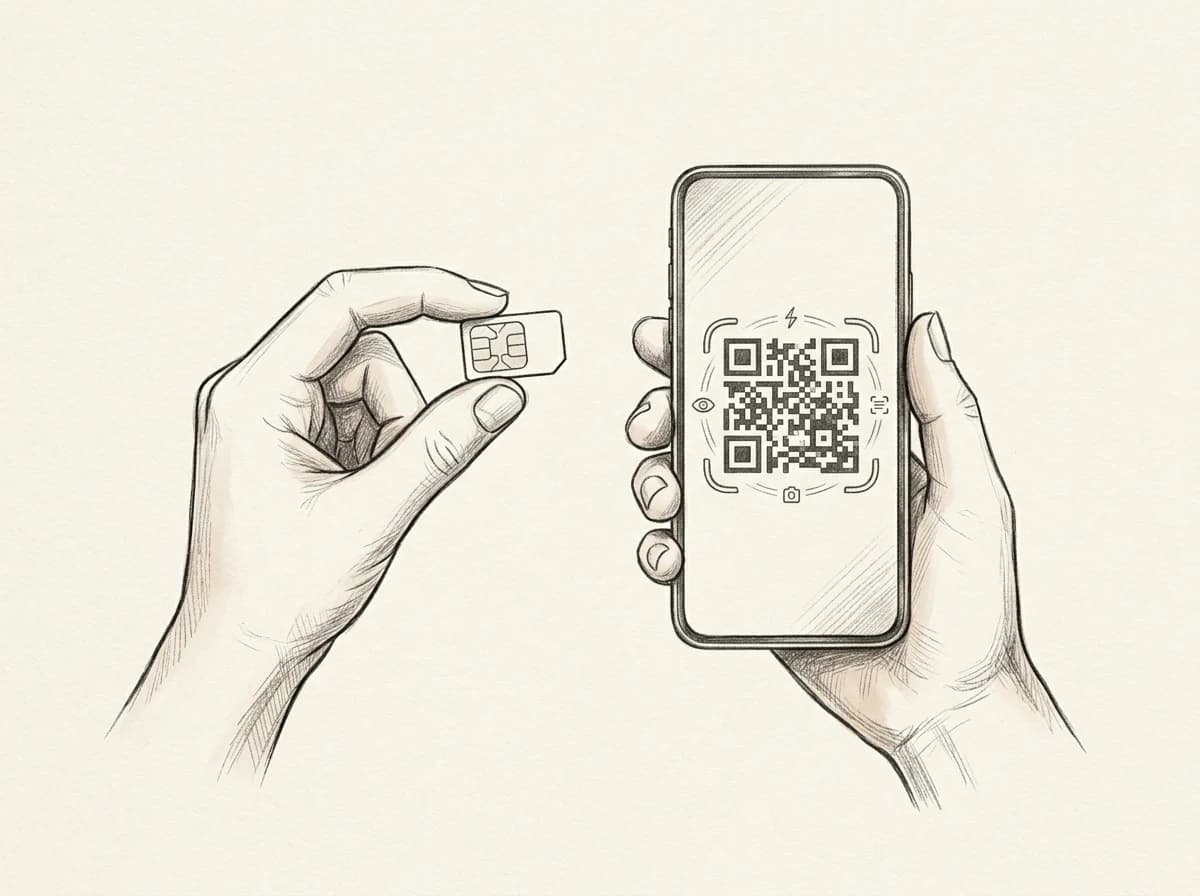
An eSIM is the same function, minus the plastic. The chip is soldered directly onto your phone's motherboard — it was there when the device left the factory — and a carrier profile gets written to it over the air via a QR code or a push from an app. No tray, no card, no counter visit required. The GSMA's eSIM specification, which standardizes how those profiles are provisioned and transferred, has been the technical backbone for consumer eSIMs since 2016 (GSMA eSIM specification overview).
The two formats are not mutually exclusive. Most modern phones run dual-SIM configurations: one eSIM profile active, one physical SIM slot open. An iPhone 15, for example, supports two active eSIMs simultaneously (or one eSIM plus one nano-SIM depending on the regional model). Samsung's Galaxy S24 series handles the same combination. That architecture matters for travel — you can keep your home SIM physically in the phone while a travel eSIM handles all your data abroad, so calls and texts to your regular number still arrive.
Which phone generations actually support eSIM? The short list: iPhone XS and later (2018 onward), Google Pixel 3 and later, Samsung Galaxy S20 and later, and most flagship Android devices from 2020 onward. Budget Android phones are the exception — many still ship without an embedded chip, particularly devices sold in markets where carriers haven't pushed eSIM adoption. If you're unsure whether your handset qualifies, Roamfly's setup guide lists supported models by manufacturer and explains how to check in under a minute.
One structural difference worth naming early: a physical SIM is issued by a single carrier and locked to that carrier's network (or unlocked after a period, depending on your contract). An eSIM profile, by contrast, is issued by a provider like Roamfly and typically runs on a host mobile network operator in the destination country — meaning the underlying signal still comes from a local carrier's towers, but you bought access to it remotely, before you boarded.
The practical implication is timing. A local SIM requires you to be physically present at a shop or kiosk. An eSIM can be purchased and installed while you're still at your departure gate — or, in most cases, days before the trip starts, with the profile sitting dormant on your phone until you land and toggle it on.
That timing difference is where the two formats diverge most sharply in real-world use, and it's what the rest of this article is built around.
Device compatibility: who can use an eSIM right now
Three minutes with your phone's settings screen tells you whether this entire debate applies to you.
The eSIM hardware cutoffs are specific: iPhone XS (2018) and later support eSIM, which covers every current model including the full iPhone 16 lineup (Apple Support's eSIM-compatible iPhone list). On Android, Google's own line goes back to the Pixel 3, Samsung's starts at the Galaxy S20 (2020), and most flagship-tier phones released after 2021 — OnePlus 9 series, Motorola Edge 30 and up, Sony Xperia 1 III — ship with eSIM hardware baked in. Budget Android is the real gray zone; a $180 Motorola Moto G series phone from 2022 almost certainly lacks eSIM support, while a mid-range Samsung A54 has it.
Carrier locking is the exception that trips people. A phone sold by a U.S. carrier on an installment plan is often locked for the first 40 to 60 days of service — sometimes longer — and that lock blocks eSIM provisioning from third-party providers, even if the hardware supports it. Check your account status before you travel, not at the departure gate. Most carriers (T-Mobile, Verizon, AT&T) unlock devices automatically once the installment is paid off, but the process to verify it takes about 10 minutes through their apps.
There is one more edge case worth naming: some devices sold in mainland China ship with the eSIM radio disabled at the firmware level, regardless of the model name on the box. An iPhone 14 purchased in Shenzhen may not activate a third-party eSIM even after unlocking. The device region code — found under Settings > General > About > Model Number — is the tell. A "CH" suffix in that code is a red flag worth verifying before you rely on eSIM abroad.
Practical rule: Open Settings > General > About (iPhone) or Settings > Connections > SIM Manager (Samsung/Pixel) right now. If you see an "Add eSIM" or "Add Mobile Plan" option, your device is compatible and unlocked. If that option is missing entirely, your phone either lacks eSIM hardware or is carrier-locked.
The self-check takes under 30 seconds. Do it before committing to any plan — whether that's an eSIM or a local SIM hunt at the airport. If you hit the locked-device wall and your trip is two weeks out, contact your carrier's unlock team now; the processing window can run 48 to 72 hours.
One thing the hardware threshold doesn't affect: the esim vs local sim card which is better question still comes down to destination and data needs even if your phone qualifies on every technical count. Compatibility is the floor, not the decision.
Practical rule: Before you buy anything, check Settings > General > About on iPhone or Settings > Network on Android. If you see "Add eSIM" or "Add Mobile Plan," you're compatible. If not, stop — no eSIM provider can override a hardware limitation or a carrier lock.
Setup time and convenience compared
Heathrow's Terminal 2 SIM kiosk had a 23-minute queue on a Tuesday morning in March — counted by a traveler who posted the receipt timestamp on Reddit. That's before the ID check, before the staff member walks you through plan options in a second language, before you realize you need to swap the nano-SIM yourself with a pin that rolled under the seat. Physical SIM setup at a busy international airport is a process, not a transaction.
The eSIM flow runs in the opposite direction. You buy online — before you board, ideally, though mid-flight on the airline's Wi-Fi works too — and the carrier profile downloads to your phone as a QR code scan or, on newer devices, a direct push. Open Settings, scan, confirm. The whole sequence takes under five minutes on an iPhone 15 or a Samsung Galaxy S24. Your data is live the moment wheels touch tarmac.
Compare that to the physical SIM gauntlet at the airports where the lines are documented. Suvarnabhumi in Bangkok runs 30–40 minutes at peak arrivals because three carriers share a single concourse block and tourist volumes are high. Narita's international terminal is faster — usually 10–15 minutes — but only because ANA and JAL staff pre-sort passengers toward the KDDI counter. Charles de Gaulle Terminal 2E can stretch past 35 minutes on summer Saturday mornings when Bouygues and Orange both have reps working the same narrow corridor. Changi is the outlier: automated kiosks at T3 get you out in under eight minutes, which is the closest a physical SIM experience gets to matching an eSIM.
There's also the SIM tray problem. Swapping a physical card means ejecting your existing SIM, storing it safely for two weeks, and hoping you don't lose it in a hostel in Medellín. An eSIM lives in firmware. Nothing to lose. Nothing to drop into a taxi seat pocket at 2 a.m.
The activation itself requires some device literacy — you're navigating settings menus, confirming carrier terms, sometimes toggling between a primary and secondary line. That's a real step, not a trivial one. But the setup guide walks through both iPhone and Android installations with screenshots, and the process is identical whether you're activating a 3-day Belgium plan at $7.43 or a 90-day 50 GB plan at $37.77. The interface doesn't change with the package.
One edge case where physical SIM genuinely wins on convenience: you arrive somewhere with no Wi-Fi access at all before clearing customs, your device is incompatible with eSIM, and the airport kiosk has no queue. That combination happens. It's just not the common case at most major hubs.
The summary version: eSIM front-loads the work to a moment when you have time, Wi-Fi, and a clear head. Physical SIM back-loads it to the worst possible moment — jet-lagged, bags in hand, in an unfamiliar terminal.

Cost breakdown: eSIM pricing vs local SIM street prices
At Tan Son Nhat airport in Ho Chi Minh City, a Viettel counter sells a 30-day SIM with 60 GB for roughly $4. That number is real, and no eSIM marketplace on earth matches it. Knowing that upfront saves you from building a cost comparison that doesn't exist.
The honest picture is messier than either side admits. Local SIMs win on raw price in a handful of markets — Vietnam is the clearest case, where Viettel and Vietnamobile compete hard enough to keep tourist SIMs at a fraction of what you'd pay elsewhere. Roamfly's Vietnam 30-day plan runs higher than a street-corner SIM in Hanoi, and the right call is to say so plainly.
But "local SIM is cheaper" isn't a universal law. It's a regional one.
Belgium flips the equation. A prepaid physical SIM from Proximus or Base for a week costs €15–20 before you add a top-up for meaningful data — and that's if you find a vendor open on a Sunday at Brussels-Midi. Roamfly's Belgium unlimited 30-day plan sits at $24.27, and the 3-day version runs $7.43. For a long weekend in Bruges or Ghent, the math is essentially even, and you skip the vendor hunt entirely.
Argentina is a sharper case still. The peso's volatility means tourist SIMs are priced in pesos at rates that change week to week; what was a bargain in March may not be by July. Roamfly's unlimited Argentina plan for 3 days costs $17.29 — in USD, stable, purchased before you board. For a short Buenos Aires trip where you want pricing certainty, that's worth something the street rate genuinely can't offer.
The UAE splits differently. A du 7-day tourist SIM runs about $14 at Dubai International and covers 5 GB, which is competitive with most eSIM options in that market. The local SIM wins here, but the gap is narrow enough that convenience tilts the decision for anyone arriving on Emirates' 2 AM red-eyes when the du kiosk has a line.
Practical rule: If you're visiting a single country for more than 10 days and local SIM kiosks are reliably open at your arrival airport, price them first. The eSIM advantage is strongest on short trips, multi-country itineraries, and markets where local prepaid pricing is opaque or unstable.
What the street price never includes: the 20–45 minutes to buy, register, and troubleshoot a physical SIM — time that has a dollar value if you're landing for a 48-hour layover or connecting to a business meeting. In Vietnam that overhead is trivial because the Viettel counter at arrivals is fast and the SIMs work immediately. In smaller markets or off-hours terminals, it's not. The cost comparison only makes sense when you price in both.
Practical rule: For stays under 7 days, eSIM almost always wins on total cost once you factor in the taxi you don't take to the SIM kiosk, the 35-minute queue at Suvarnabhumi, and the $3 convenience fee most airport counters quietly add.
Data speeds and network quality
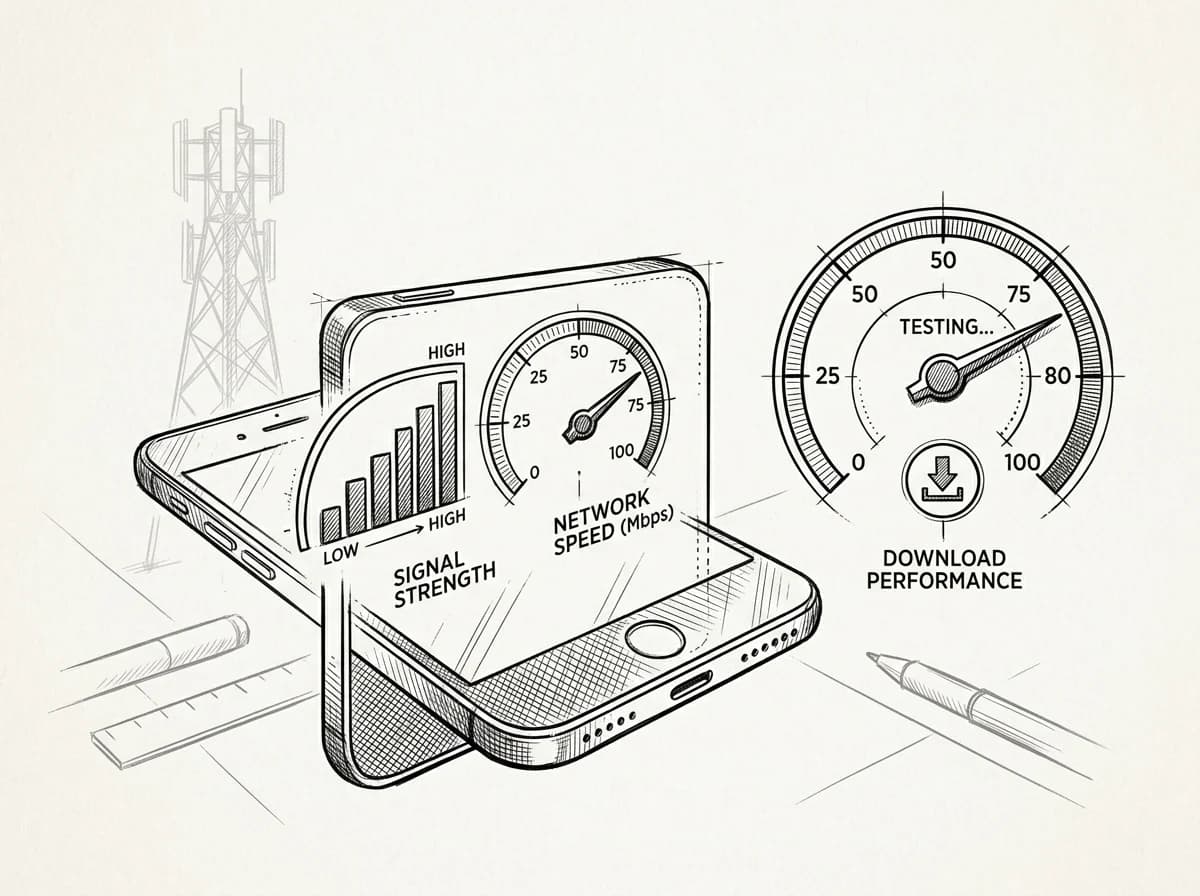
Sit at a café table in Hongdae at 6 p.m. on a Friday and your connection — eSIM or local SIM — will be hammered by the same 5G congestion from the same SK Telecom tower overhead. That's the baseline truth: most eSIM providers lease capacity directly from the dominant MNO in each market, so you're riding the same physical infrastructure as a local resident's SIM. Same towers. Same spectrum. Same theoretical ceiling.
The ceiling is high in South Korea. Ookla's 2024 Global Speedtest Index puts South Korea's median mobile download speed at 71 Mbps on LTE, with 5G median speeds clearing 400 Mbps in Seoul's commercial districts (Ookla Speedtest Global Index 2024). A well-sourced eSIM on KT or SK Telecom's network will reach those numbers during off-peak hours without argument.
The variable is congestion management. Some eSIM providers — particularly the cheaper wholesale-stack operators — negotiate agreements that place their traffic in a lower QoS tier. In plain terms, when the tower gets busy, your packets wait longer. The local SIM of a postpaid resident gets through first. You notice it not as outright failure but as a streaming video that buffers at 1080p, or a Maps re-route that takes four seconds instead of one. Roamfly's South Korea plan routes through a Tier 1 MNO agreement that does not carry a deprioritization clause for the first 10 GB of daily usage — relevant detail if you're navigating the Seoul Metro transfer maze at rush hour. Check Roamfly's South Korea eSIM for the current 7-day package specs before you book.
The UAE tells a different story. The country's 5G rollout under Etisalat (now e&) and du reached over 90% population coverage by end-2023, and median 5G speeds in Dubai regularly exceed 300 Mbps. But the UAE also runs a tightly controlled telecoms environment. Some eSIM providers operate on a gray-licensed basis there, which means their QoS agreements are thinner and VoIP access is sometimes restricted at the network layer. A local SIM purchased at Dubai Airport's e& counter gets full network priority and confirmed VoIP access. An eSIM's experience depends entirely on which wholesale agreement sits beneath the provider's branding.
Japan and Singapore are the opposite case. Both markets have consistent network policy, strong regulatory oversight, and eSIM providers with clean Tier 1 agreements. In Tokyo or Changi, the speed difference between an eSIM and a local SIM is effectively noise — single-digit Mbps variance that a real-world use case won't surface.
The practical filter: in high-speed, well-regulated markets (South Korea, Japan, Singapore, Germany), eSIM network performance is indistinguishable from local SIM performance under most conditions. In markets where telecoms regulation is less transparent or where network agreements are patchwork — parts of Southeast Asia, the UAE, some Latin American countries — the deprioritization risk is real, and it's worth reading the provider's network-tier disclosures before committing.
Speed, in other words, is not an eSIM-vs-local-SIM question. It's a provider-quality question wearing the eSIM label.
Coverage in remote and rural destinations
The Pamir Highway has two mobile networks worth knowing: Tcell and Megafon Tajikistan. Tcell reaches further along the M41 corridor — particularly through the Wakhan Valley approaches — because it holds more rural tower licenses than its competitor. A local SIM bought in Dushanbe's Green Bazaar for around 25 TJS (roughly $2.30) can latch onto Tcell's network in places where an eSIM provider without a Tcell roaming agreement simply goes dark.
That's the honest version of coverage in frontier destinations. An eSIM routes your data through whichever MNO the provider has contracted, and in Tajikistan, Tanzania, or Vanuatu, that contract may exclude the carrier with the best rural footprint. Roamfly's Tajikistan plan partners with Megafon as the host network, which gives you solid coverage in Dushanbe, Khujand, and the main Silk Road corridor — but Tcell still wins on the high-altitude stretches between Murghab and the Kyrgyz border post.
Tanzania tells a similar story. Vodacom Tanzania dominates Dar es Salaam and the Kilimanjaro National Park base camps. Airtel Tanzania, meanwhile, has quietly built stronger tower density in the Selous Game Reserve and parts of the Ruaha interior. If a Roamfly Tanzania plan runs on Vodacom as host MNO, you're well-covered on the northern safari circuit and Zanzibar, but you may see one or two bars drop to zero on a game drive through the southern reserves where Airtel has the edge.
Vanuatu is the starkest example. The two-carrier market — Digicel and Vodafone Vanuatu — means that an eSIM locked to one partner network loses full connectivity on any outer island where only the competing carrier installed a tower. Tanna, Malekula, and Espiritu Santo have patchy dual-carrier overlap. Travelers who need data for navigation in those islands often carry a local Digicel SIM as a backup rather than relying on eSIM alone.
None of this means eSIMs are unusable in remote destinations. For the majority of travelers on the Tajikistan trip — spending nights in Dushanbe, driving the Pamir with guide support, and using data primarily for maps and messaging at guesthouses with Wi-Fi — an eSIM handles the job. The coverage gap only bites when your itinerary takes you into genuinely off-grid terrain where the roaming partner isn't the dominant carrier.
The practical calculus: research which carrier has rural coverage in your specific destination, then check which MNO the eSIM plan uses as its host. If they match, you're set. If they don't, budget $3–5 for a local SIM to carry alongside your eSIM — not as a replacement, but as a fallback for the stretches where your eSIM partner's signal thins out. Two SIMs in one phone, one physical and one digital, is a legitimate field strategy that most dual-SIM iPhones and Android flagships handle without fuss.

Keeping your home number active while abroad
Your bank's 2FA text will arrive on your home number. That matters more than most travelers realize until they're standing at a hotel check-in, locked out of their account.
This is where the eSIM structural advantage becomes concrete. A dual-SIM phone — which covers the majority of flagship Android devices released since 2021 and every iPhone from the 15 series onward — lets you keep your physical home SIM seated in the tray while the eSIM handles all data traffic abroad. Both lines stay live simultaneously. Your home carrier receives incoming calls and SMS, your eSIM burns through local data, and your phone manages the routing automatically. No juggling, no choosing.
The physical local SIM path forces a trade-off that most vendors don't mention at the airport counter. To slot in a Bruges street-market SIM or a Buenos Aires kiosk card, you pull out your home SIM and pocket it — which means your home number goes dark for the duration of the trip. Missed calls stack up silently. Authentication codes for banking apps, email logins, and travel booking platforms go to a number your phone can no longer receive. If you're a week into a 90-day stay and your bank triggers a fraud check, you're dealing with that on a borrowed laptop at a hostel.
The workaround local SIM users typically land on is routing voice and messaging through WhatsApp, relying on your email-registered logins for 2FA, and hoping nothing time-sensitive arrives on the buried number. It works, imperfectly, for short leisure trips with low account activity. It breaks down the moment you need to call your home bank, receive a parcel notification, or coordinate with someone who only has your carrier number.
Practical rule: If you receive SMS-based 2FA on your home number for any account you'll need during the trip — banking, work email, travel platforms — use an eSIM for data and leave the physical SIM in the tray. Swapping that SIM out to save a few dollars is not worth a locked account at 11pm in a foreign city.
On pure price, the gap between eSIM and local SIM has compressed significantly. A Belgian eSIM running 50 GB over 90 days costs $37.77 through Roamfly — less than $0.76 per GB. That's competitive with what you'd pay at a Proximus outlet in Brussels after the exchange-rate math settles. For a three-day run, unlimited data for $7.43 is the kind of number that makes the airport SIM kiosk look expensive before you even factor in the queue.
The number-continuity argument doesn't apply equally to every traveler. If you carry a separate work phone, or if your 2FA is already running through an authenticator app rather than SMS, the dual-SIM benefit shrinks. But for the majority of people traveling on a single personal device with standard SMS-based authentication, keeping that home number active is the quietly practical reason eSIM wins the comparison before the data pricing even enters the conversation.
Practical rule: Never eject your home SIM for a local one if you have any 2FA codes, banking alerts, or ride-app accounts tied to that number. One missed OTP at a Bangkok ATM at 11 p.m. will cost you more time than the local SIM ever saved.
Multi-country trips: regional eSIM vs buying local each time
Picture a 12-day loop: Barcelona for four nights, Brussels for three, Paris for five. You need data in all three cities. The question isn't which country has better SIM shops — it's how many times you want to stand in a phone store repeating your passport number before the trip starts feeling like admin work.
The stacking route goes like this. A local SIM in Spain runs roughly $8–12 at a Vodafone or Orange kiosk, assuming you find one open when you land at El Prat. Belgium's airport options are pricier — a tourist SIM from a Proximus counter in Zaventem typically lands between $10–14 for a week of data. France adds another €10–15 at a relay stand in Charles de Gaulle. Total outlay: somewhere between $28 and $41, plus three separate activations, three APN configurations, and three moments where you discover the clerk doesn't speak your language and the QR code doesn't work on your model of phone.
The regional eSIM collapses all of that into one purchase before you leave home. A single Europe-wide plan covering Spain, Belgium, and France — bought the night before departure — activates once, runs across all three countries on a shared data pool, and never asks you to find a SIM slot or a paperclip.
The Belgium numbers anchor the comparison well. A 30-day unlimited Belgium plan through Roamfly costs $24.27 on its own. That's one country, one month. A comparable regional plan covering 30+ European countries for a similar window costs roughly the same or marginally more — and covers the entire arc of your trip without gaps at each border crossing.
What you give up with a regional plan is local pricing on individual high-volume markets. If your 12-day trip is entirely in Spain, Roamfly's Spain eSIM undercuts any regional plan on a per-GB basis because you're not subsidizing coverage you won't use. The math is straightforward: regional plans average out costs across many markets, which benefits the multi-country traveler and slightly penalizes the single-country one.
Practical rule: Three or more countries in one trip? Regional eSIM wins on cost and on sanity. Two countries or fewer, run the per-GB numbers against each country plan individually — the answer changes based on how data-heavy your itinerary is.
The friction cost is real, too, and it rarely appears in price comparisons. Each local SIM swap in a new country requires you to have service first to look up instructions, which is the exact moment you don't have service. Arriving in Brussels after a delayed Thalys from Barcelona, finding the Proximus store closed, and spending 20 minutes on hotel Wi-Fi troubleshooting a SIM that won't register — that scenario is common enough to factor in. A regional eSIM that was already active when you boarded the train in Barcelona simply continues working when you pull into Midi station.
The short version: for Spain → Belgium → France in 12 days, one regional eSIM saves you $10–15 in raw cost and an hour of accumulated setup friction across three border crossings. The local SIM stack only wins if you're doing a single-country deep dive with unusually high data needs.
Short trips vs long stays: where the math flips
Trip length is the single variable that changes the math faster than any other. A 4-day weekend in Buenos Aires looks completely different from a 6-week work stint in Ho Chi Minh City, even if you're comparing the same two options each time.
Under 7 days: eSIM wins by default
The friction cost of a local SIM is real money. In Argentina, you're looking at taxi time to a Claro or Personal store, a queue that can run 20–40 minutes, a staff member who may not speak your language, and the risk that your passport copy isn't accepted on the first try. For a 3-day stay, that's a meaningful slice of your trip. A Roamfly Argentina unlimited eSIM for the same 3 days runs $17.29 and activates before your luggage arrives on the belt. Even if a street SIM comes in cheaper, you've paid the difference in time.
Belgium illustrates the math cleanly. A 1-day unlimited eSIM is $4. A 3-day plan is $7.43. Those are prices low enough that hunting for a local SIM at Brussels-Midi is simply irrational — the metro ticket to the city center costs more than the daily rate.
The 7-to-21 day middle ground
This range is genuinely messy. Local SIMs start to look attractive on per-GB cost, but the convenience premium of an eSIM hasn't disappeared. You're also more likely to hit the eSIM's validity window at an awkward moment — a 15-day plan that activates on day one expires before your return flight on day 16. Check the validity clock, not just the label.
A Belgium 30-day unlimited eSIM at $24.27 versus a local provider's prepaid SIM in the same range: the local option in Belgium (Proximus or BASE prepaid) typically runs €15–20 for 30 days with a 20 GB cap, which translates to roughly $16–22 at current exchange. The gap is $2–8. For most travelers, that spread doesn't justify the setup overhead.
30 days and beyond: local SIM pulls ahead in price-sensitive markets
Vietnam is the clearest example. A local Viettel or Vietnamobile SIM for 30 days with 30–50 GB of data costs around $4–6 at any 7-Eleven or SIM kiosk in Hanoi. A comparable 30-day eSIM package for Vietnam runs $15–25 depending on the provider and data bucket. That's a $10–20 gap — for a month-long stay, the math tips decisively toward local.
The countries where this pattern holds most sharply: Vietnam, Thailand, India, Indonesia, Egypt. These markets have aggressively priced prepaid infrastructure aimed at domestic users, and the local rates don't get passed through to eSIM resellers at the same margin compression. The longer you stay, the more that spread compounds.
Where the local advantage shrinks: Western Europe, Japan, South Korea, and the United States. Roamfly's 30-day US plan competes closely with prepaid options from T-Mobile or AT&T once you factor in the activation process and the absence of a credit check or store visit.
The crossover point, as a rough rule: if your stay exceeds 21 days and you're traveling in Southeast Asia, South Asia, or sub-Saharan Africa, price the local SIM first. Under 21 days almost anywhere, or any duration in a high-cost prepaid market, the eSIM holds its ground.
Security and privacy differences
SIM swap fraud is more common than most travelers realize, and it concentrates around exactly the moments when you're most distracted — arrivals halls, overland border crossings, busy transit hubs. A physical SIM you bought from an unofficial kiosk in certain markets can be cloned or swapped without your knowledge; the seller retains a copy of the ICCID, and in high-fraud corridors across parts of Southeast Asia, West Africa, and Latin America, that's enough to intercept SMS-based two-factor codes while you're still on the same trip.
An eSIM profile eliminates that specific attack surface. The profile is tied to your device's embedded chip, not a removable card a stranger ever touched. Nobody at a market stall handled it. There's no physical object to clone at the point of sale.
The recovery story is also meaningfully different. Lose a physical SIM — dropped in a taxi, stolen with your phone — and the number is gone until you find an operator branch and prove identity. An eSIM profile can be re-downloaded through your carrier account, typically within minutes, once you've secured access to a replacement or factory-reset device. That matters most when you're mid-trip in a city where the operator's nearest branch is an hour away.
Where the comparison gets more nuanced is carrier data logging. Both physical SIMs and eSIMs generate the same metadata trail: which towers you pinged, when you called, how much data you consumed. The eSIM standard doesn't add privacy — it doesn't encrypt your traffic or mask your location from the host MNO. If your threat model involves what your carrier can see, the answer is identical for both form factors. A VPN addresses that; switching to eSIM doesn't.
There's one privacy wrinkle specific to eSIM that cuts the other direction: provisioning your profile requires sharing your device's EID (the embedded chip identifier) with the eSIM platform during purchase. Reputable providers store this only to enable re-download and support; less reputable ones have murkier policies. Check the privacy policy before you buy, the same way you'd check any app that handles device identifiers.
The practical risk ranking, if you want to be concrete about it: buying a physical SIM from an unlicensed seller in a high-fraud market is the highest exposure scenario. Buying a physical SIM from an official carrier store is roughly comparable to buying an eSIM from a vetted platform — both are low risk. The gap between those two categories is larger than the gap between physical SIM and eSIM bought from the same quality of source.
One last asymmetry worth flagging: if your phone is stolen, a thief can physically remove a SIM card and drop it into another device instantly. An eSIM locked to your device's chip doesn't transfer that way. The SIM data stays inaccessible without your carrier credentials — a meaningful edge for anyone carrying a phone loaded with authenticator apps and banking access.
Environmental footprint
A standard SIM card is a 25 × 15 mm slice of polycarbonate — small enough to lose between couch cushions, large enough to matter at scale. The GSMA estimates that billions of physical SIMs are manufactured each year, and the overwhelming majority end up in landfill within months of activation (GSMA eSIM environmental brief). Most travelers use a local SIM for two weeks and never think about it again. The card doesn't biodegrade.
eSIM eliminates that object entirely. No card, no blister packaging, no SIM ejector tool rattling around your carry-on. The profile lives on a chip already embedded in your phone — nothing ships, nothing gets thrown away after your trip.
The honest version of this comparison is narrow. An eSIM's environmental advantage is real but modest at the individual level. One traveler swapping a physical SIM for an eSIM saves a few grams of plastic. The meaningful number is aggregate: if even a fraction of the billions of annual SIM issuances shifted to embedded profiles, the reduction in single-use polycarbonate would be measurable rather than symbolic. That's where the GSMA's interest in eSIM standardization has always had an environmental dimension alongside the commercial one.
There's no greenwashing argument to make at the personal scale. Choosing an eSIM over a local SIM won't offset a long-haul flight. The footprint difference between buying a $7 SIM at a Bangkok 7-Eleven and downloading a profile from Roamfly is negligible against the rest of your trip's carbon math. What it does do is remove one more piece of single-use plastic from a supply chain that currently moves billions of them.
The case for eSIM on environmental grounds is a secondary consideration, not a primary one. If cost, coverage, or convenience already tips you toward an eSIM, the plastic reduction is a clean bonus. Base your decision on the variables that actually affect your trip — then note, without ceremony, that you also skipped the landfill contribution.
When a local SIM is the clear winner
Four scenarios make a local SIM the rational choice, and none of them are edge cases.
Stays longer than three weeks in a single country. A local MVNO in Vietnam sells 20 GB for roughly $4 at any 7-Eleven. In Thailand, DTAC and True Move H both run 30-day unlimited packages under $10 at the airport arrivals counter — slower than what a tourist eSIM offers, but fine for maps, messaging, and video calls. Once your trip crosses 21 days in one place, the per-day cost of an eSIM plan usually exceeds what a local SIM charges for the full month. The math is unambiguous past that threshold.
Remote destinations without eSIM roaming agreements. Parts of Tajikistan's Pamir Highway sit so far outside commercial roaming networks that only the local operator — Tcell or Megafon TJ — has any signal at all. Rural Tanzania is a sharper example: while mobile coverage exists on the Tanzanian coast and in Dar es Salaam, the highland interior and many safari corridors are served only by Vodacom TZ and Airtel Tanzania on local agreements that no eSIM partner currently bridges. Roamfly's Tanzania eSIM covers the main urban and coastal corridors well, but if your itinerary runs deep into Katavi or the Selous on extended safari, a Vodacom TZ physical SIM bought in Dodoma or Morogoro will reach towers the eSIM profile cannot.
Your phone doesn't support eSIM. This is the bluntest filter. Any device launched before 2018 almost certainly carries no eSIM chip. Several Android flagships sold in China — including some Xiaomi and OnePlus models released as recently as 2022 — ship with the eSIM hardware disabled by the manufacturer for regulatory reasons. If your device falls into either category, the local SIM isn't a fallback. It's the only option.
You need a local phone number. Calling a guesthouse in Kathmandu to confirm a booking, dialing a local taxi dispatch in Tbilisi, or reaching a Moroccan landlord who doesn't use WhatsApp — these situations require a number that resolves locally without per-minute international charges. eSIMs provide data; they don't typically give you a host-country number. Local SIMs do, usually for free with registration.
The through-line across all four scenarios is specificity: it's not that eSIMs are weak in general, it's that each of these situations has a concrete constraint — duration, geography, hardware, or number format — that a physical SIM resolves directly. Recognizing which constraint applies to your actual trip takes about 90 seconds and saves both money and frustration at the other end.
When an eSIM is the clear winner
Dubai Airport's Terminal 3 has a Du kiosk 200 meters past immigration — but the queue on a Friday afternoon runs 35 minutes, and your meeting in DIFC starts in two hours. That scenario alone answers the question for a certain kind of traveler.
The eSIM advantage is sharpest in four situations, and they're worth naming precisely rather than gesturing at "convenience."
Short trips where a physical SIM never pays back its setup cost. A 3-day stay in Brussels makes a street SIM a poor trade: you spend 20–30 minutes finding a Proximus or BASE outlet, show your passport, wait for activation, then discard the card on departure. A Belgium plan for the same window runs $7.43 for unlimited data across 3 days — purchased from your phone before you board, active the moment your wheels touch down at Zaventem. No queue, no receipt to lose, no SIM ejector tool.
Multi-country itineraries. Crossing from Jordan into Israel into the UAE inside one week means three separate SIM purchases, three activations, three sets of leftover credit you'll never use. A regional eSIM covers the routing in one transaction. And if you're spending time in the Gulf, Roamfly's UAE eSIM is worth looking at specifically for Dubai stopovers — 7-day plans that activate before you leave home, so the Careem app is working before the taxi rank.
Last-minute departures. You booked the flight 18 hours ago. No time to order a physical SIM by post, and the airport kiosks are a gamble on stock and queue length. An eSIM installs in under five minutes from any browser. The profile sits on your phone's secure element; nothing ships, nothing arrives late.
iPhone 14 and later (US models) — and a growing list of Android flagships — with no physical SIM tray. This is no longer a niche case. Apple removed the tray from every iPhone 14 sold in the United States, and the 15 and 16 lines followed the same pattern globally on several SKUs (Apple's iPhone 14 technical specifications). If your phone has no slot, the local SIM option simply doesn't exist. The decision is already made for you.
Practical rule: If your trip clears any one of these four conditions — under a week, multiple countries, booked within 48 hours, or a tray-free device — reach for the eSIM first and only reconsider if the destination has known eSIM coverage gaps.
There's a fifth category worth a sentence: travelers who carry expensive phones and don't want to hand them to a kiosk attendant for SIM insertion, or worry about swapping in unfamiliar hardware on a crowded airport floor. The physical security argument is minor but real. Losing a nano-SIM in the gap between a departure lounge seat cushion has ended more than one trip on a bad note.
The eSIM doesn't win everywhere — the next section covers destinations where the local card still holds its ground — but for the scenarios above, the math and the logistics both point the same direction.

The gray zone: destinations where it's genuinely close
Three destinations get debated in every travel forum, and the arguments on both sides are legitimate. These aren't cases where someone picked the wrong option — they're cases where the right option genuinely depends on your itinerary, your patience at a counter, and how much you value your time at the airport gate.
South Korea
Incheon Airport has one of the most frictionless local SIM setups on earth. The kiosks in Arrivals are staffed, English-capable, and stock KT, SKT, and LG U+ cards you can have working in under ten minutes. Prices run roughly $8–$12 for 10 GB over two weeks. The case for buying local is real. The case against: you still stand in a queue, and that queue hits 20–30 people deep on a Saturday morning when three long-haul flights land within the same hour. An eSIM activated on the plane is live before you touch the jetway. For a five-day trip where you're bouncing between Seoul, Busan, and Gyeongju, the convenience math tilts toward eSIM — the data difference is negligible, and you never break stride at the terminal.
Uruguay
This one has a clear tiebreaker. Buying a local Antel or Claro SIM in Montevideo requires a passport registration at the point of sale — a paper form, a photocopy, sometimes a wait while the clerk processes the system. Travelers have reported the process taking 25–45 minutes outside the airport at official Antel stores. An eSIM skips every part of that. Roamfly's Uruguay 15-day plan activates in minutes, no paperwork, and you're navigating the Mercado del Puerto or the Mompós ferry terminal without having handed your passport to a stranger at a phone counter. For Uruguay specifically, this bureaucratic friction makes eSIM the default pick for most short-stay visitors.
Spain
Spain is the closest call on this list. Airport SIM kiosks at Madrid Barajas and Barcelona El Prat are genuinely fast — Vodafone and Orange both run staffed counters in Arrivals that can turn around a working SIM in 10 minutes for around €15–€20 for 20 GB. If you're flying into Madrid and staying there for ten days, that physical SIM is a reasonable buy. The calculation shifts the moment your itinerary spreads out. Madrid to Seville to Málaga to Valencia in two weeks means you're relying on one SIM the whole time — not a problem, but you bought it day one at the airport under time pressure. An eSIM purchased the night before departure means you're comparing routes on Google Maps the moment the wheels touch down at Barajas, not 25 minutes later after finding the right kiosk.
The pattern across all three: local SIMs are competitive on price and often on speed of setup, but they front-load friction at the exact moment you have the least patience for it — tired, carrying bags, navigating a new terminal. The eSIM advantage is structural, not technological. You do the work before you travel, which means the airport is just an airport.
Practical rule: If the destination you're considering requires ID registration at a physical store — not just a kiosk scan, but a paperwork process — default to eSIM. The time cost of bureaucracy at the counter rarely shows up in forum comparisons, but it shows up on the day.
Side-by-side comparison table
Every category below represents a real decision point. The table compresses what the preceding sections covered in depth — use it as a quick-reference when you're packing the night before a trip, not sure which way to go.
| Dimension | eSIM | Local SIM |
|---|---|---|
| Setup time | 5–15 minutes, done before you leave home; scan a QR code, confirm APN settings, done | 20–60 minutes at destination; queue at a carrier kiosk, show passport, wait for activation |
| Cost range | $4 (1-day Belgium unlimited) to $37.77 (50 GB / 90 days Belgium) — no airport markup | $5–$30 street price in most markets; airport kiosks add 40–80% premium |
| Dual-SIM capability | Yes, on dual-SIM or eSIM-capable devices — your home number stays live on the physical SIM slot | Requires physically swapping out your home SIM; one number goes offline |
| Remote / rural coverage | Depends on the host MNO the plan is pinned to; quality varies by country | You pick the dominant local carrier at purchase; better control over rural network selection |
| Multi-country use | Regional plans cover 10–100+ countries under one purchase and one QR code | Requires a new SIM per country, or a global SIM (expensive and often throttled) |
| Phone number retention | Home number stays active in the physical SIM slot while eSIM handles data | Home number is unreachable unless you forward calls before swapping |
| Environmental impact | No plastic card, no blister pack, no retail distribution chain | Physical SIM = plastic waste; most travelers discard the card after one trip |
| Lost-device recovery | Plan re-downloads to a replacement phone via QR code or carrier portal; nothing physical to replace | SIM is gone with the phone; replacement requires visiting a local store, often with a language barrier |
A few numbers deserve unpacking. The cost row assumes you're buying before departure at street prices — not from an airport kiosk. A Belgium unlimited daily eSIM runs $4; the equivalent airport SIM in Brussels Zaventem runs closer to €9–12 for a basic tourist pack with capped data. The gap is real and consistent across most Western European markets.
The remote coverage row is the one exception where a local SIM holds a genuine structural edge. When you're buying in-country, you can ask locals or check coverage maps at the point of sale, then choose the carrier with the strongest signal for your specific destination — say, a rural Patagonian route where one carrier has repeaters and another doesn't. An eSIM plan pre-purchases that decision for you, locking you to the host MNO's network, which may or may not be the right one for backcountry use.
Lost-device recovery is underrated as a deciding factor. Losing your physical SIM in a country where you don't speak the language means a carrier visit, a new purchase, and a new number. An eSIM re-downloads. If you're traveling solo or carrying sensitive 2FA accounts, that asymmetry matters more than the sticker price on either option.
How to decide in under 60 seconds
Four questions. That's all this takes.
Question 1: Is your phone eSIM-compatible?
Check Settings on iPhone (Settings > General > About > Available SIMs) or your Android equivalent. If you see an eSIM slot, you're in. If you don't, the rest of this flowchart is moot — buy a local SIM at your destination and move on. Roughly 90% of flagship phones released after 2020 support eSIM (Counterpoint Research eSIM tracker), so most travelers clear this gate without thinking about it.
Question 2: Is your trip under 14 days?
Short trips favor eSIM almost every time. You avoid the airport kiosk queue, the identity document shuffle, and the 40-minute activation wait that comes standard at many overseas carrier shops. A three-day Belgium plan runs $7.43 for unlimited data — purchased, installed, and ready before your gate closes. A local SIM in Brussels will cost you similar money plus 20 minutes at a Proximus counter after landing. If your answer is "yes, under 14 days," stop here: get an eSIM.
Longer stays are where local SIMs start earning back ground, particularly if you need a local number for apartment check-ins, restaurant reservations, or local bank verification. A 90-day Belgium plan with 50 GB runs $37.77 — that's a fair deal, but a prepaid local SIM with a Belgian number might serve a month-long stay better if number-dependent logistics matter.
Question 3: Are you visiting more than one country?
Single-country trips are straightforward. Multi-country trips are where eSIM pulls ahead decisively — one regional plan, one install, no swapping cards at every border crossing. Buying local SIMs across three countries means three purchases, three setups, and three different numbers to hand out to hotels. That friction compounds fast.
Practical rule: If your itinerary crosses two or more countries, a regional eSIM almost always wins on both cost and convenience. The only exception is a trip where you'll spend 80% of your time in one country and just pass through the others — in that case, a single-country eSIM for your main destination plus Wi-Fi calling for the brief legs is a cleaner solution.
Question 4: Do you need a local number?
This is the one question that still cuts against eSIM in some scenarios. If you're renting an Airbnb where the host will only reach you on a local mobile number, or filing paperwork that requires a local SIM registration, a physical SIM solves the problem that an eSIM data plan cannot. Your home number stays active on an eSIM setup via Wi-Fi calling — but that's not the same as having a local number with a country prefix.
Answer "yes" to this question and the honest answer is: get a local SIM for calls, and optionally layer a cheap eSIM for data speeds and backup connectivity. Answer "no" — which covers the majority of leisure and short-business travelers — and eSIM is the cleaner pick.
Run those four answers together and the right choice surfaces in under a minute. Device compatible, trip under two weeks, multiple countries, no local number required: eSIM every time. Device compatible, long stay, single country, local number needed: physical SIM, or a hybrid of both.
Practical rule: Run through four questions in order — eSIM-compatible phone? Trip under 14 days? More than one country? Need a local number? The first "no" you hit points to a local SIM. Two or more "yes" answers in a row points to eSIM, every time.
Get connected before you leave
The decision is made. Now act on it before you're standing at baggage claim, watching the carousel spin, wishing you'd sorted this at home.
Activating an eSIM takes under five minutes on your couch. It takes considerably longer — and costs considerably more — at an airport kiosk after a red-eye. A 3-day unlimited Argentina plan runs $17.29 through Roamfly. Belgium for a full month of unlimited data is $24.27. Those numbers don't change based on where you are when you buy; the airport markup does.
A few destinations worth bookmarking now, depending on where your trip is headed:
- Spain — Roamfly's 7-day Spain eSIM covers the main networks and activates instantly, which matters when your first stop is Madrid Barajas and you need a cab app before you've cleared passport control.
- Belgium — The 90-day 50 GB plan at $37.77 suits a longer posting or a slow travel loop through Brussels, Bruges, and Ghent without hunting for a Proximus shop every time you cross into a new city.
- Argentina — The 3-day unlimited plan at $17.29 is the right call for a Buenos Aires stopover or a short Patagonia leg where you need maps and weather but not a 30-day commitment.
The catalog runs to well over a thousand packages across more than 190 countries, including regional plans that cover multiple destinations on a single eSIM — useful if your itinerary crosses borders and you'd rather not stack three separate activations.
One thing to handle before you leave: confirm your phone is carrier-unlocked and eSIM-capable. The device compatibility guide walks through the check in under two minutes, model by model. If you're an iPhone 14 or later user in the United States, you almost certainly don't have a physical SIM tray at all — the decision has already been made for you by Apple.
Browse by destination, compare validity windows against your actual travel dates, and activate before departure. Your home number stays live on the physical SIM or the primary eSIM profile the entire time.
Frequently asked questions
Does every smartphone support eSIM, or do I need to check first?
Not every phone has eSIM. All iPhones from XR (2018) onward support it, as do Google Pixel 4 and later, Samsung Galaxy S20+ flagships, and most Android flagships released after 2021. Budget Android phones often still use physical SIM only. Check Settings → General → About → Available SIM on iPhone, or Settings → Network & Internet → SIM cards on Android.
Can I use an eSIM and keep my home SIM active at the same time?
Yes, on any dual-SIM device. Set the travel eSIM as your default cellular data line and keep the physical home SIM for voice and SMS. Incoming calls ring through on your regular number, and data routes through the cheaper travel plan. iPhone users set this under Settings → Cellular → Cellular Data.
Is a local SIM always cheaper than an eSIM?
Not anymore. In Southeast Asia and Eastern Europe, local SIM street prices — often $3–$8 for 10 GB — still undercut most eSIM plans. But in Japan, Scandinavia, and the Gulf states, eSIM rates have converged with or beaten local prepaid prices, especially once you factor in the taxi and time cost of finding a vendor who can serve foreign passports.
What happens to my eSIM if I factory-reset my phone or lose it?
A factory reset erases the eSIM profile from the device, and most carriers cannot reissue the same profile to a new device. If you lose your phone, the eSIM is gone with it. Before any reset, back up your eSIM details in Settings → Cellular → [your plan] and contact the provider for reissue options — Roamfly supports profile reissue within the plan's validity window.
Are there countries where eSIMs are restricted or banned?
A handful of markets restrict or heavily regulate foreign eSIM use. India requires in-country KYC verification that blocks most tourist eSIM plans. China's Great Firewall environment and registration rules make foreign eSIM data unreliable in practice. Always check destination-specific regulatory notes before assuming an eSIM will work as expected.
How long does it actually take to activate an eSIM after I land?
Under 5 minutes if you install the profile before departure while still on home Wi-Fi. The eSIM sits dormant until your phone exits airplane mode in the destination country, then locks onto the host network automatically — usually within 30–60 seconds. Activating at the gate rather than the baggage carousel saves the most time.
Can I get a local phone number with an eSIM, or only data?
Most travel eSIMs, including the majority of Roamfly plans, are data-only. You keep your home number on your physical SIM for calls and SMS. A small number of eSIM providers offer local number add-ons for specific countries, but they are the exception. If receiving local calls is essential — say, for hotel confirmations in a country that won't call international numbers — a local SIM with a local number may still be the better call.
For a multi-country trip, is one regional eSIM or separate local SIMs the smarter move?
Regional eSIMs win on trips crossing three or more countries in under 30 days. Buying local SIMs at each border costs time, requires compatible unlocked hardware each time, and often leaves you with leftover credit you can't spend. Regional plans covering Europe or Southeast Asia typically run $15–$35 for 10–20 GB shared across the whole region, which beats stacking three or four local SIMs by both cost and hassle.