Compare eSIM travel prepaid data plans by price, data, and coverage — real numbers from 1 GB at $4.50 to unlimited, so you buy the right plan before you land.
Carrier roaming in Austria runs $10–15 per day on most North American plans — that's $70–105 for a week of access you could cover with a $4.50 / 1 GB prepaid eSIM. The math doesn't require a spreadsheet.
Traditional roaming charges have barely moved in a decade despite eSIM adoption accelerating sharply; GSMA Intelligence's 2025 roaming cost report found the average international day-pass still sits above $10 in most G20 markets (GSMA Intelligence 2025). Prepaid eSIM plans price per gigabyte, not per calendar day, so a light traveler who uses 3 GB over a week pays $13.50 total instead of $70+. Heavy users can flip to unlimited — 10 days of unlimited data in Austria runs $35.50, still well under the roaming equivalent.
The structural advantage is control. You buy exactly what your trip needs, activate on landing, and the clock starts running on data consumed — not on days your phone sat in a conference room on Wi-Fi. For a deeper breakdown of how the two formats stack up, the eSIM vs physical SIM cost comparison covers the full range of scenarios.

The four plan types and when each makes sense
Four plan types cover almost every travel scenario. Knowing which fits your trip stops you from paying $35.50 for ten days of unlimited data when a $4.50 / 1 GB / 3-day Austria plan would have covered a long weekend in Vienna.
Local plans lock to one country — ideal for single-destination trips or when you're spending 80%+ of your time in one place. Regional plans span clusters like the EU or Southeast Asia; useful when you're hopping borders every few days. Global plans trade coverage breadth for slightly higher per-GB cost — worth it if your itinerary crosses three or more regions. Unlimited plans sound appealing but often cap speeds after 2–5 GB of full-bandwidth use, so a video-heavy traveler actually hits a wall.
Practical rule: If your trip is one country and under a week, match the validity tightly — a 3-day local plan at $4.50 costs 87% less than a 10-day unlimited at $35.50. Unused days don't roll over. See how plan pricing is structured before you overshoot.
The unlimited tier earns its price on itineraries with long train rides, heavy Maps use, or video calls daily.
Practical rule: If your itinerary touches three or more countries in under 21 days, a regional plan beats stacking local ones — even if the per-GB rate looks cheaper. The validity gaps between individual country plans will eat your buffer days before you clear the last border.
Prepaid eSIM plan comparison: price, data, and validity
Numbers make the decision easy. Here's how the main plan tiers stack up across real catalog entries — local, regional, and global — so you can match the right structure to your itinerary before you buy.
| Plan type | Example destination | Data | Validity | Price |
|---|---|---|---|---|
| Local | Austria 🇦🇹 | 1 GB | 3 days | $4.50 |
| Local | Austria 🇦🇹 | Unlimited | 10 days | $35.50 |
| Regional | Europe (multi-country) | 10 GB | 30 days | ~$18–22 |
| Regional | Middle East (incl. UAE) | 5 GB | 15 days | ~$12–15 |
| Global | 100+ countries | 3 GB | 30 days | ~$25–30 |
The local Austria plans show the classic trade-off: $4.50 buys three days of light use, but unlimited for ten days costs eight times more — worth every cent if you're streaming maps and video calls through Vienna and Salzburg. Regional Europe plans split the difference for multi-country trips, typically running $1.80–2.20 per GB across 30+ countries. Global plans carry the highest per-GB cost but eliminate the swap problem entirely.
eSIM connections are forecast to exceed 3.4 billion active lines by 2026 (Juniper Research eSIM forecast), which means catalog depth and competition keep pushing these prices down — what you see in this table reflects today's floor, not a ceiling.
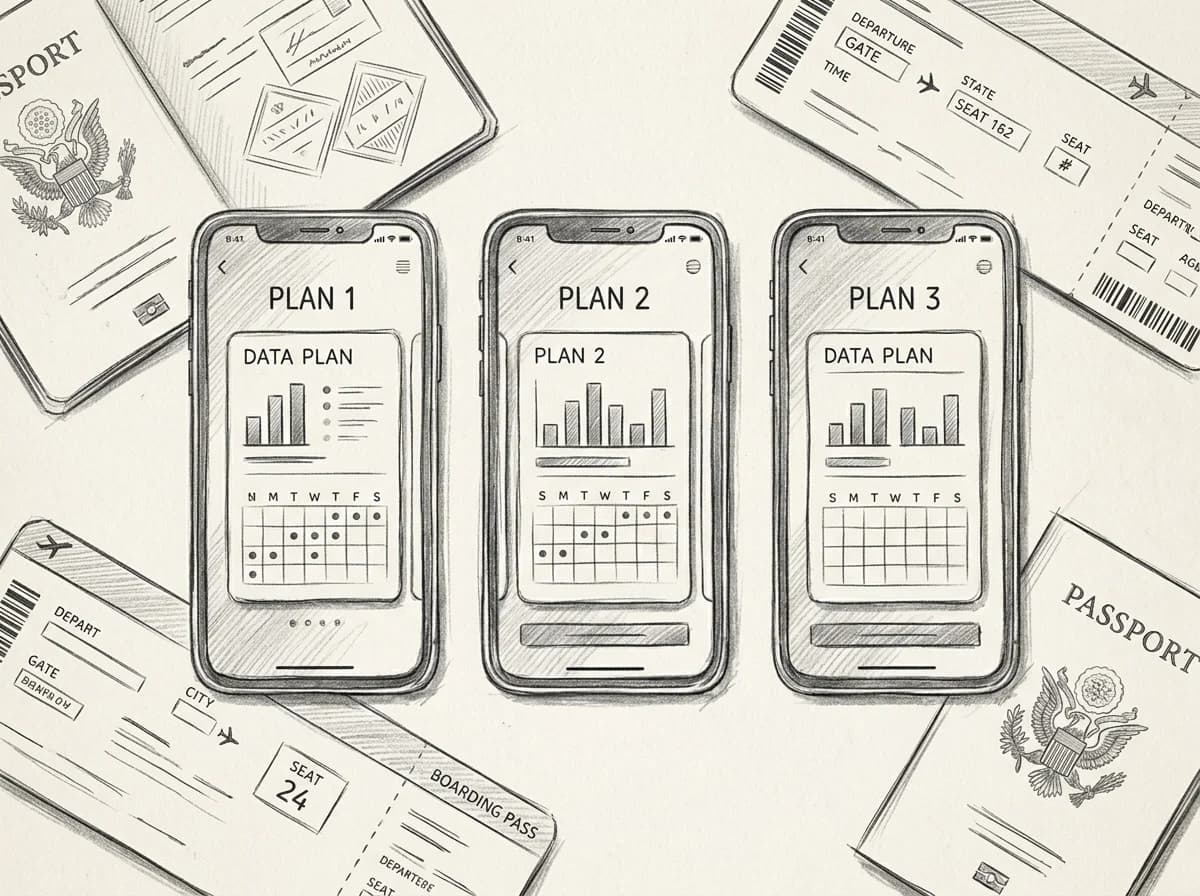
4 Prepaid eSIM Plan Types Compared
| Plan Type | Best For | Watch Out For |
|---|---|---|
| Single-country | 1 destination, 7–30 days | Useless the moment you cross a border |
| Regional | 2–5 countries, same trip | Speed caps in smaller markets |
| Global | 6+ countries or last-minute trips | Costs more per GB than regional |
| Top-up / Unlimited | Heavy streamers, remote workers | Fair-use throttle after daily cap |
How to pick the right plan for your trip length
Trip length is the single variable that should drive your decision. Everything else — price per GB, carrier network, regional vs local — comes second.
1–7 days: A local plan wins. Four dollars buys 1 GB for three days in Austria; you won't burn through that on maps and messages. Paying for 10-day validity on a weekend trip is just dead time on the clock.
8–21 days or multiple countries: A regional plan starts making sense, especially if you're crossing borders. Roamfly's Europe travel plans cover 30+ countries under one plan — far cheaper than stacking individual country plans at every border.
3+ weeks: Go unlimited or plan to stack. Austria's unlimited 10-day option runs $35.50; buy two back-to-back and you've covered 20 days for $71 — still less than most carrier roaming bills for a single week.
Practical rule: Never let your validity expire mid-trip without a backup plan purchased. Networks don't warn you. Your data cuts at midnight on day 10 whether you're at the Mompós ferry terminal or Vienna Hauptbahnhof.
Pick the right plan in 60 seconds
- Count your trip days — validity must cover them all
- List every country you'll enter, even briefly
- Check if 5G matters or LTE is enough
- Confirm your phone is unlocked and eSIM-capable
- Estimate daily data use — streaming adds 1 GB/hr
- Buy on home Wi-Fi before you reach the airport
Practical rule: Activate mid-flight or at the departure gate — not after you clear customs. Your home carrier's international roaming session starts the moment your phone pings a foreign tower, and most carriers bill by the calendar day with no credit for the 20 minutes you spent in the arrivals hall.
Installing your eSIM before departure
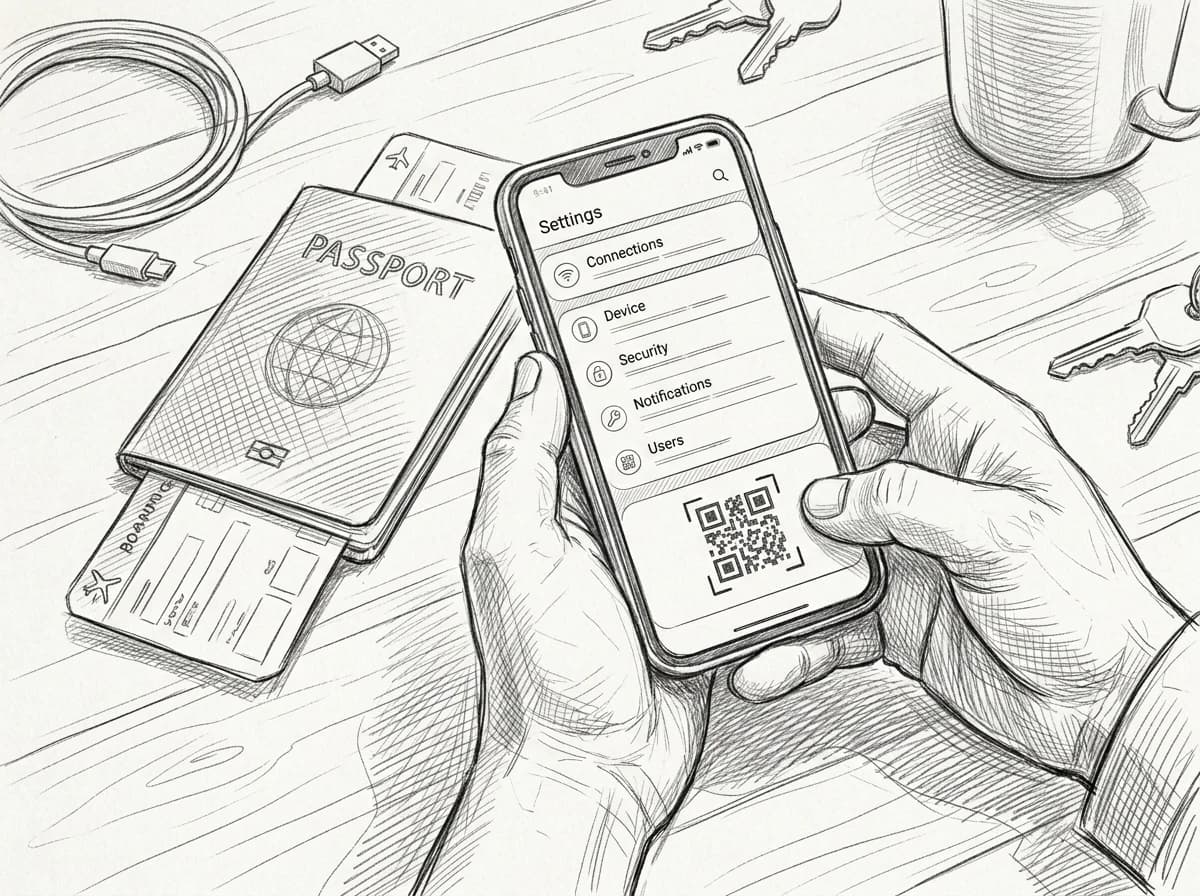
Three steps cover 95% of installs. Download the QR code profile from your confirmation email, scan it in Settings → Mobile Data → Add eSIM, then toggle the new line on before you board.
The full process takes under four minutes on most devices — the installation guide walks through every screen for both iPhone and Android, including the manual activation code fallback if your camera struggles with the QR scan.
Timing matters more than most travelers expect. You can download the profile at home, then delay activation until wheels-down — useful if your physical SIM still has domestic minutes you want to burn. Alternatively, flip the eSIM live during the final boarding shuffle; gate Wi-Fi is usually strong enough. What you want to avoid is landing in Vienna and hunting for airport Wi-Fi just to pull the profile down.
Your eSIM profile and your active data line are two different things. Profile downloaded ≠ data running. Confirm the new line shows signal before you clear passport control.
Get connected before you leave
The plans are live, the prices are fixed, and your phone is ready. Whether you're heading to Vienna for a long weekend on 1 GB / 3 days at $4.50, or settling in for ten days of unlimited Austrian data at $35.50, the catalog covers both ends of that spectrum.
Browse by country, filter by trip length, and you'll land on a package in under two minutes. No contracts, no SIM card mailed to an address you won't be at, no carrier store queues at the airport.
Ready to get connected? Roamfly's UAE 7-day eSIM activates in under 5 minutes.
The prepaid framing matters here: you pay once, the data is yours for the validity window, and the bill stops there. Pick your destination, match the GB to your habits, and you're done before your boarding pass prints.
Frequently asked questions
Does my phone support eSIM travel prepaid data plans?
Most phones from 2019 onward do. Every iPhone from XR, every Google Pixel from 4, and Samsung Galaxy S20+ flagships ship with eSIM (Apple Support — Use eSIM on iPhone). On iPhone, check Settings → General → About → Available SIM. On Android, Settings → Connections → SIM Manager. If you see an 'Add eSIM' or 'Download SIM' option, you're compatible.
When should I activate my prepaid eSIM — before or after landing?
Install before departure while you're on home Wi-Fi — scanning the QR takes under 3 minutes and the eSIM sits dormant until it finds a host network abroad. Activation (when your data clock starts) happens automatically once your phone leaves airplane mode at the destination. Some plans let you trigger activation manually, which saves validity days on long-haul flights.
Can I use a prepaid eSIM as a hotspot for my laptop or tablet?
Usually yes, but check the plan spec before buying. Most Roamfly data-only plans support personal hotspot tethering. A small number of regional plans — particularly budget-tier options under $5 — restrict tethering at the carrier level. The plan detail page on Roamfly flags hotspot support explicitly so there's no guesswork.
What happens when I use up all my prepaid data?
Depends on the plan type. Hard-cap plans cut data entirely at the limit — your phone shows 'No Internet' until you top up. Throttled plans drop speed to around 64–128 kbps, enough for maps and messages but not video. Check the plan's 'After Data' line in the Roamfly catalog before you buy if uninterrupted access matters.
Are unlimited prepaid eSIM plans actually unlimited?
The data volume is genuinely unlimited, but all unlimited plans on the market carry a fair-use threshold — typically 1 GB to 5 GB at full 4G/5G speed, after which speeds throttle to 1–3 Mbps (GSMA fair-use policy guidelines). That's fine for navigation and messaging; streaming 4K is off the table past the threshold. GSMA's fair-use policy framework covers why carriers enforce this.