

The honest comparison of eSIM for students studying abroad in Europe — semester-length data, multi-country coverage, and what actually costs less than…
A 30-day tourist eSIM looks fine in a Heathrow arrivals hall. It expires somewhere around week four — right before midterms, when you're in a different country than the one you bought it for, and your group chat is the only thing keeping your project team coordinated.
The structural problem is validity, not price. Most tourist plans cap at 7, 15, or 30 days, which means a 16-week semester forces at least four separate purchases, four activation windows, and four moments where coverage can drop. Multiply that across the 30-plus countries a typical Erasmus student touches — a long weekend in Prague, a reading-week trip to Lisbon, a field course in rural Tuscany — and single-country tourist plans become genuinely unworkable, not just inconvenient.
The right comparison unit is the semester block: 90 to 120 days, multi-country, with enough data to cover lectures streamed over hotel Wi-Fi and maps running in the background across borders. Understanding why travel eSIMs underperform local SIMs on cost is the first step to choosing a plan that actually lasts the term.

Europe regional eSIM vs single-country plan: the math
Stack four country plans and you're paying for four activations, four expiry clocks, and the mental overhead of tracking which runs out when you're standing at the Ljubljana bus station at 11 p.m. A single regional Europe plan sidesteps all of it.
The math favors regional coverage once your itinerary crosses two countries. A dedicated Austria plan typically runs $12–18 for 10 GB with a 30-day ceiling — fine for a Vienna exchange semester where you never leave. But semester-abroad students routinely hit four to six countries: a Belgium host city, weekend trips into France, a reading week in Albania, a Eurostar hop to London. Stacking individual plans for that route can push total spend past $60 before March, and each renewal is a separate purchase decision that costs real time (GSMA Intelligence European eSIM Adoption Report).
Practical rule: If your semester itinerary touches three or more countries, a regional plan's per-GB cost beats stacking by 30–40% on average (GSMA Intelligence European eSIM Adoption Report) — and you repurchase once, not six times.
For Austria-specific weekends, Roamfly's Austria travel guide covers local coverage quirks worth reading before you arrive.
Practical rule: If your semester runs longer than 60 days and you'll visit more than two countries, a regional Europe eSIM beats stacked single-country plans at roughly the 6-week mark — that's when repurchase costs and validity gaps erase any per-GB savings you thought you had.
How much data a student actually needs per month
Zoom eats data faster than most students expect. A single 90-minute lecture streams at roughly 1.5 GB on standard video quality (Zoom bandwidth requirements – Zoom Support) — three lectures a week puts you at 18 GB in Zoom alone before you've opened Google Maps, uploaded a PDF to Moodle, or watched anything on Netflix during the train from Bologna to Florence.
Pull those numbers back to realistic usage and a clearer picture forms: Zoom at 3–4 hours weekly (roughly 6 GB/month), navigation and browser use (1–2 GB), light streaming (3–5 GB), and file uploads and email (under 1 GB) lands you between 11 and 14 GB a month — consistent with Ericsson's finding that Western European smartphone users averaged 14 GB monthly in 2024 (Ericsson Mobility Report 2024).
Practical rule: Budget 15 GB as your monthly floor. Drop below that only if your university guarantees eduroam Wi-Fi in every building you'll use — and most don't.
Treat anything under 8 GB as a weekend-trip plan, not a semester tool. Understanding what a SIM actually is also clarifies why throttled data after a soft cap wrecks a Zoom call mid-lecture in ways a dropped connection doesn't.

Regional eSIM vs Single-Country Plan
| Factor | Europe Regional eSIM | Single-Country Plan |
|---|---|---|
| Best for | Multi-country travel, semester trips | One city, one country, full stop |
| Coverage | 26–40 countries, one profile | 1 country only |
| Validity | 30–90 days, extendable | Typically 7–30 days |
| Top-ups when you travel | one plan covers it | buy new plan each country |
| Cost over 4 months | Lower stacked total | Higher — repeated purchases |
Practical rule: Budget 12 GB per month as your floor, not your ceiling — one week of Zoom-heavy lecture catch-up plus a weekend in Kraków will hit 4 GB alone. Choosing a plan under 10 GB/month means topping up by November.
Country coverage that actually matters for study-abroad routes
Erasmus routes are messier than most coverage maps admit. A student based in Vienna will hit Budapest on a long weekend, cross into Albania for a beach trip via Tirana, and maybe slide into Andorra for a ski run — none of which sit inside the EU's roaming bloc.
Albania is the critical edge case. It operates outside EU roaming rules, so a plan labeled "44 European countries" often stops at the Greek border. Check the carrier list before you buy: plans that explicitly name Albania in their coverage table — not just "Europe" — are the ones that hold. Andorra is a similar trap; it's landlocked between France and Spain but not in the EU, and many regional eSIMs drop data the moment you enter Pas de la Casa.
The study-abroad routes that catch students off guard most often are the Balkans corridor (Albania, North Macedonia, Kosovo) and the micro-states (Andorra, Monaco, San Marino). Roamfly's Albania eSIM guide breaks down which regional plans extend coverage there versus which ones require a separate add-on.
Practical rule: Pull up the plan's full country list — not the headline number — and search for Albania and Andorra by name before committing to any semester-long regional package.
Before Your First Semester Lecture
- Confirm your phone is unlocked and eSIM-capable
- Buy a 30-GB-or-higher regional Europe plan
- Install and label the eSIM profile on home Wi-Fi
- Keep your home SIM active for bank verification texts
- Set the eSIM as your default data line before boarding
- Test data connectivity before leaving the departure gate
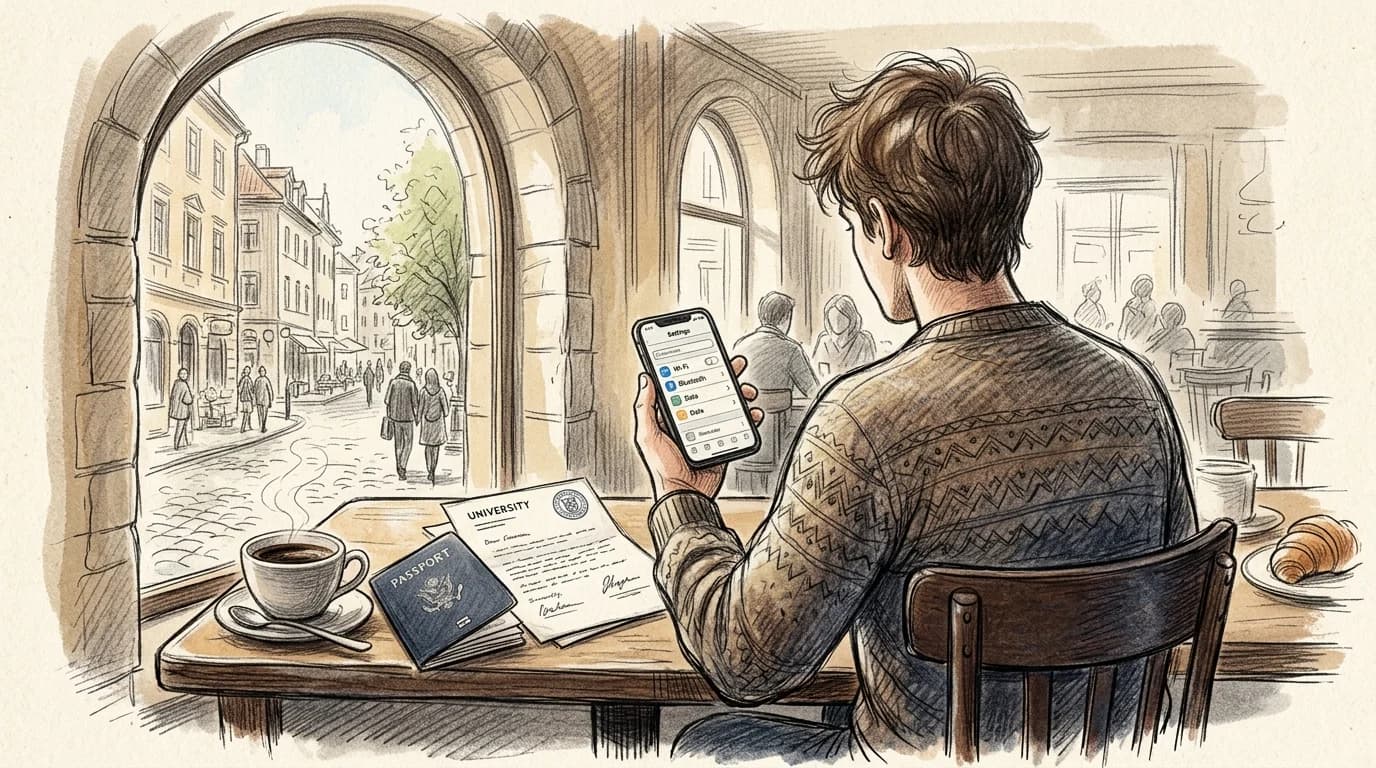
Setting up your eSIM before the semester starts
Most activation problems happen in the 20 minutes after landing — not because the eSIM is broken, but because the setup was skipped at home. Do it before your flight boards.
Start with compatibility. Apple's device list confirms which iPhone models support eSIM (iPhone XS and later, with some carrier-locked exceptions) (Apple Support – Use an eSIM on your iPhone) and which Android devices do the same (Apple Support eSIM compatibility). If your phone is carrier-locked — common with US contract devices — contact your carrier to request an unlock at least a week before departure. That process can take 48 to 72 hours.
Install the eSIM on your home Wi-Fi, then set it to "off" until you land. Keep your domestic SIM active in the primary slot throughout the semester — your bank's two-factor authentication texts and any calls to US numbers will route through it without international charges. The iPhone activation guide walks through the dual-SIM settings that make this work cleanly on iOS 17 and later.
Label each line clearly in Settings. "Europe Data" and "Home Calls" takes four seconds and saves real confusion at Charles de Gaulle.
Get connected before your first lecture
Ready to get connected? Roamfly's Europe student eSIM plans activate in under 5 minutes — long before your Erasmus orientation ends.
Your SIM slot is already full. Roamfly's Europe regional plans install over Wi-Fi, activate the moment you land at Frankfurt or Barcelona-El Prat, and run for up to 90 days without a top-up interruption. No queuing at a carrier shop on Rue de Rivoli with a jet-lagged brain and a landlord waiting for your arrival text.
The esim for students studying abroad in europe who need multi-country coverage: pick a regional plan that follows you across borders automatically, so a weekend in Vienna doesn't cost you a separate SIM swap. Roamfly's Austria travel guide covers exactly which networks activate there.
One purchase. One QR code. Done before your first lecture.
Frequently asked questions
Can I use one eSIM across all European countries for a full semester?
A regional Europe eSIM covers 30–36 countries on a single plan, so travel from Germany to Portugal or a weekend in Prague stays on the same data pool. Validity on most Roamfly Europe plans runs 30 or 90 days — for a full semester, buy the 90-day plan or stack a second one before the first expires.
Is an eSIM cheaper than buying a local SIM card in my host country?
For single-country stays longer than 6 weeks, a local SIM from a carrier like Free Mobile in France or Vodafone Germany often undercuts a regional eSIM on raw price. The regional plan wins if you travel to 3 or more countries during the semester — you avoid paying separate SIM fees each time you cross a border.
How do I receive 2FA texts from my home bank while on a European eSIM?
Keep your home carrier SIM active in the second SIM slot and set it to receive SMS only — not cellular data. Your US or UK number stays reachable for bank texts and verification codes, while the European eSIM handles all data. Most dual-SIM iPhones (XS or later) and Android flagships support this split natively.
Will a European eSIM handle Zoom calls and university VPNs reliably?
Yes, provided you're on LTE or 5G. A Zoom video call consumes roughly 1.5 GB per hour at 720p — factor that into your monthly data estimate. University VPNs add overhead but don't require a special plan; any eSIM that delivers unthrottled data works. Avoid plans that throttle below 5 Mbps after a soft cap.
What happens if my eSIM data runs out mid-semester?
Roamfly top-ups apply within 60 seconds through the app — no new QR code, no reactivation. If your plan's validity window has expired rather than just the data, you'll need to purchase a new plan. Set a usage alert at 80% in your phone's mobile data settings so you're never caught mid-lecture without a connection.