eSIM travel data plans cost compared across regions, plan types, and trip lengths — real prices, real coverage gaps, and how to avoid overpaying by $40+.
A 1 GB day pass in Germany runs about $3. That same gigabyte in St. Eustatius — a Dutch Caribbean island of fewer than 4,000 people — costs closer to $9, and a 20 GB / 30-day local plan there lists at $188.50. Same data, wildly different number.
Infrastructure density explains most of the gap. Western Europe has dozens of competing MNOs, dense fiber backhaul, and carrier-neutral wholesale markets that push per-MB costs down hard; a small island depends on a single operator, expensive submarine cable capacity, and almost no competitive pressure. The GSMA's 2025 mobile data pricing report confirms the pattern: markets with three or more active MNOs consistently show retail data prices 40–60% lower than single-operator markets (GSMA Intelligence 2025 mobile data pricing).
What looks like a pricing puzzle is really a supply chain. Understanding that reframes how you shop — you're not comparing gigabytes, you're comparing the cost of delivering those gigabytes to a specific tower in a specific place. That context is what makes eSIM travel data plans cost compared across regions worth doing before you book, not after.

Local vs regional vs global plans: the cost structure
Three plan categories, three pricing logics. Local plans are the cheapest per-GB when you're staying put — a single-country 20 GB / 30-day package for St. Eustatius and Saba runs $188.50, which sounds steep until you realize local Caribbean infrastructure costs are genuinely high and no regional plan covers those islands at all. In popular corridors like Western Europe or Southeast Asia, local plans regularly drop below $1.50/GB.
Regional plans charge a premium for flexibility — typically 1.5–2× the per-GB rate of the cheapest local option — but that markup pays for itself the moment you cross a border. A five-country Schengen hop on a single regional plan beats stacking five local eSIMs by $30–60 and eliminates mid-trip reinstalls.
Practical rule: If your itinerary touches three or more countries in 30 days, a regional plan wins on both cost and convenience. One country, one extended stay? Go local every time.
Global plans carry the highest per-GB price of the three and exist mainly for frequent multi-region travelers — the kind profiled in Roamfly's guide to eSIMs for business travelers worldwide. They rarely make sense for a single two-week trip.
Practical rule: If your trip covers three or more countries in the same region, a regional plan beats stacking local plans once you cross 8 GB total. Below that threshold, a single-country plan almost always wins on price per GB — sometimes by $2.00 or more.
Cost by region: Europe, Asia, Americas, and the islands
The Caribbean is where eSIM pricing gets brutal. St Eustatius and Saba — two Dutch islands with a combined population under 4,000 — run $188.50 for a 20 GB / 30-day local plan, more than most travelers spend on data across an entire two-week Europe trip.
That Europe contrast is real. UK prepaid-style eSIM packages regularly land below $15 for 10 GB; France, Germany, and Spain cluster in the $12–$20 range for 30-day validity. Asia goes lower still: India plans frequently hit 1 GB per dollar, and Thailand or Vietnam packages often deliver 10 GB for under $10. The Americas split hard — the US and Canada sit in the mid-range ($20–$35 for 10–15 GB), while isolated island territories like the Caribbean or South Pacific outliers can triple that figure because a single carrier controls local infrastructure with no competitive pressure.
For a detailed breakdown of one of the cheapest regional benchmarks, Roamfly's UK prepaid data plan guide shows exactly what the low end looks like. Remote islands are the exception, not the rule — but they can wreck a data budget if you don't check before you book.

eSIM plan types: cost structure
| Factor | Local eSIM | Regional eSIM | Global eSIM |
|---|---|---|---|
| Coverage | 1 country | Up to 30+ countries | 150+ countries |
| Price per GB | Lowest | Mid-range | Highest per GB |
| Best for | 1-country trips | Multi-stop tours | Frequent world travel |
| Validity flexibility | 7–30 days typical | 15–30 days typical | 30–90 days typical |
| vs carrier roaming | Up to 90% cheaper | Up to 80% cheaper | Up to 70% cheaper |
Short trip vs long stay: where the math flips
A 7-day trip to Sana'a doesn't need 30 days of validity — but the price gap can trick you into buying more than you'll use.
Roamfly's Yemen 15-day plan runs at a lower per-day rate than stacking two 7-day packages back-to-back, so a single two-week window usually wins for trips under 12 nights. The 30-day tier makes sense only when your stay genuinely crosses that midpoint — otherwise you're paying for 15 days of dead validity after you've already landed home.
Practical rule: If your departure is within 15 days of arrival, buy the 15-day plan, not the 30-day. You cannot pause validity once the eSIM activates, so unused days evaporate.
The math flips differently on data-heavy plans. St. Eustatius and Saba's local 30-day eSIM offers 20 GB for $188.50 — that's $9.43 per GB, which only beats two sequential 10 GB plans if you consume the full allocation. Light users hitting 6–8 GB should always size down and let price-per-GB guide the tier, not raw validity.
eSIM vs carrier roaming: real costs
| Factor | Roamfly eSIM | Carrier Roaming |
|---|---|---|
| Setup | Done before you board | Auto-connects, no action |
| Keeps your number | (dual-SIM) | |
| Typical daily cost | Flat plan, no daily fee | $5–$15 per day add-on |
| Overage charges | (data cap stops use) | often steep |
| Top-ups | In-app, instant | Call carrier or log in |
Practical rule: On trips of 10 days or fewer, skip the 30-day plan entirely — you pay for 20 unused days of validity. A 7-day or 15-day plan for the same data bucket runs $4–$8 cheaper in most markets, including Yemen and Southeast Asia.
eSIM vs carrier roaming: the real price gap
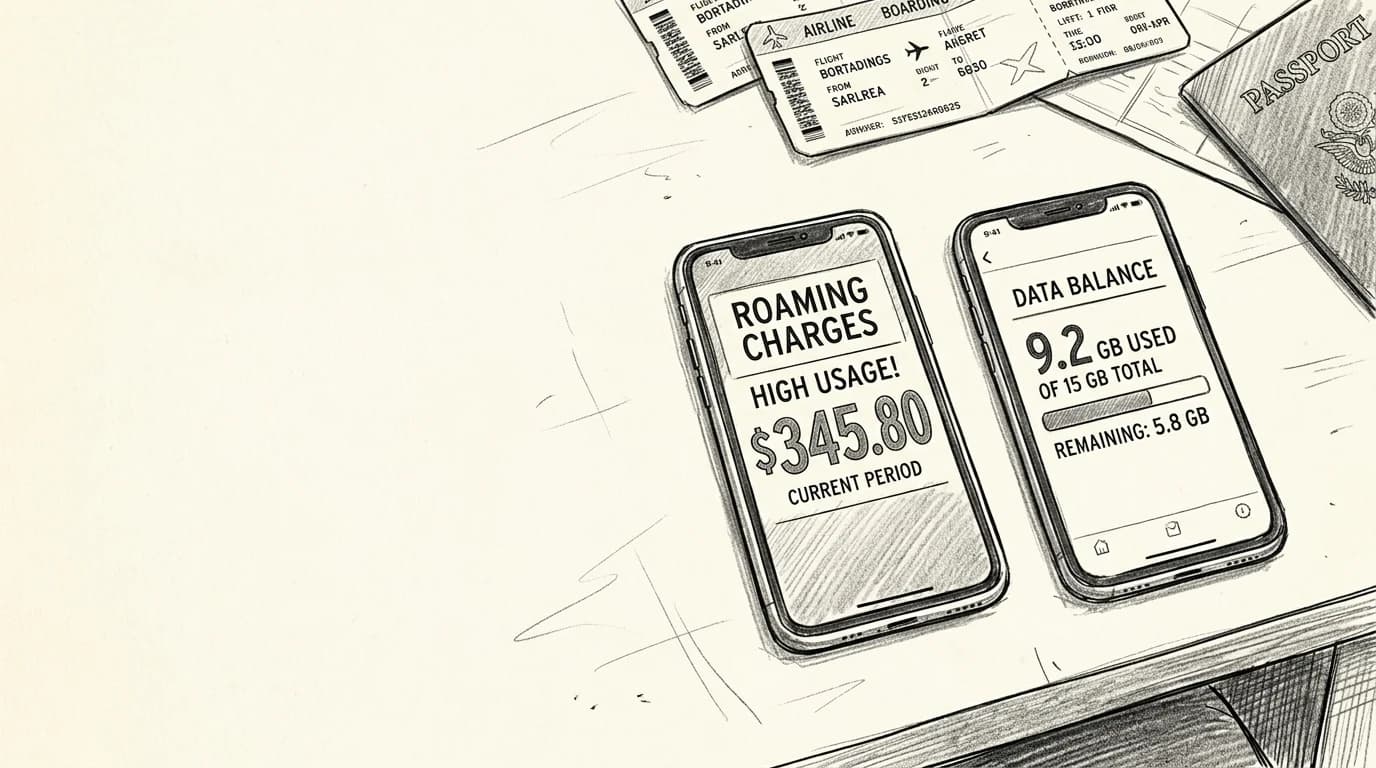
AT&T's International Day Pass runs $12 per day (AT&T International Day Pass pricing). Ten days in Rome means $120 before you've touched a cappuccino. T-Mobile's Go Further add-on cuts that to $5/day, but you're still at $50 for a standard 10-day trip — and throttled to 512 Kbps after the first 512 MB of high-speed data per day (T-Mobile Go Further international plan details).
A comparable Roamfly Italy eSIM runs roughly $18–22 for 10 GB over 30 days. That's the entire trip covered, not a daily meter running while you sleep. The break-even against AT&T lands at day two; against T-Mobile, day five — after that, every additional day the carrier plan costs you more than the eSIM did in total.
The gap widens on longer trips. Carrier day passes reset every 24 hours regardless of usage; an eSIM allocates a fixed pool you draw from at your own pace, so a light-data day doesn't burn the same as a heavy one. For eSIM travel data plans cost compared across carriers, that structural difference matters more than the headline rate (AT&T International Day Pass pricing).
See how a major carrier stacks up in detail in the Vodafone vs travel eSIM breakdown.
Get connected before you leave
Activation takes under five minutes. That matters at 11 p.m. when your flight lands at Incheon and the airport SIM kiosks have a 20-person queue.
Browse Roamfly's full catalog by destination — Europe day-pass bundles from under $3, Asia regional plans covering 15+ countries, and local packages for harder-to-serve stops like St. Eustatius and Saba at 20 GB for 30 days. Every plan shows the price before you commit. No carrier store, no roaming shock on the back end.
The one step most travelers skip: installing the eSIM profile at home, on Wi-Fi, before the trip starts. Your physical SIM stays active until you toggle the eSIM on. The setup guide walks through the full iPhone process in four steps — takes less time than printing a boarding pass.
Ready to get connected? Roamfly's full eSIM catalog ships in under 5 minutes.
Frequently asked questions
What is the average cost of an eSIM travel data plan?
Entry-level country plans start around $4–$6 for 1 GB over 7 days in competitive markets like Western Europe and Southeast Asia. Regional plans covering 30+ countries run $15–$35 for 10–15 GB. Caribbean and Pacific island plans are outliers — expect $18–$30 for 3 GB because carriers there operate on thin-margin satellite backhaul infrastructure.
Is a regional eSIM cheaper than buying separate country plans?
For trips spanning three or more countries inside 21 days, a regional plan almost always wins on per-GB cost. A Europe regional plan at $22 for 15 GB beats stacking three 5 GB country plans at $8 each — you save $2 and avoid juggling separate QR codes and expiry dates.
Why are eSIM plans so expensive in the Caribbean and Pacific islands?
Most island networks lease capacity from satellite uplinks or single-operator submarine cables with no local competition to drive prices down. Roaming agreements with global carriers are thin, so eSIM providers pay higher wholesale rates and pass them through. A 3 GB plan in Fiji or St. Lucia can cost four times the equivalent in Germany.
How much data do I actually need for a 7-day trip?
Light use — maps, messaging, boarding passes — runs about 300–500 MB per day. Add 30 minutes of streaming and casual social browsing and you're closer to 1–1.5 GB daily. A 7-day trip for most travelers lands between 5 GB and 10 GB. If you're navigating full-time or tethering a laptop, budget 2 GB per day minimum.
Can I top up an eSIM plan if I run out of data mid-trip?
Yes — most Roamfly plans support in-app top-ups that activate within 60 seconds without rescanning a QR code or reinstalling the eSIM profile. The key check before purchase: confirm the plan shows 'top-up eligible' in the plan details, since a small number of carrier-locked packages are fixed-quota with no extension option.