
Planning DRC travel? Here's what eSIM for Democratic Republic of Congo actually covers — networks, costs, and what journalists and business travelers need to…
The DRC covers 2.3 million square kilometers and has fewer paved roads than Portugal. That geographic reality punishes network infrastructure: towers go up where roads let engineers reach them, and most of the country's interior simply doesn't qualify. The GSMA Mobile Connectivity Index 2024 scores the DRC at 26 out of 100 on connectivity — one of the lowest readings on the African continent (GSMA Mobile Connectivity Index 2024).
Power compounds the problem. Load-shedding in Kinshasa runs 12–18 hours a day in some neighborhoods (World Bank — DRC Energy Sector Overview), and towers without functioning backup generators go dark with the grid. For business travelers and journalists on assignment in Goma or Kasai, a dropped connection isn't an inconvenience — it's a security gap.
Roaming on a home-country SIM here is expensive and unreliable in equal measure; standard international rates can hit $10–$15 per MB with some European carriers (GSMA Roaming Guidelines and Pricing Overview). Understanding how eSIM for business travelers works globally before you depart closes that cost exposure before it opens.
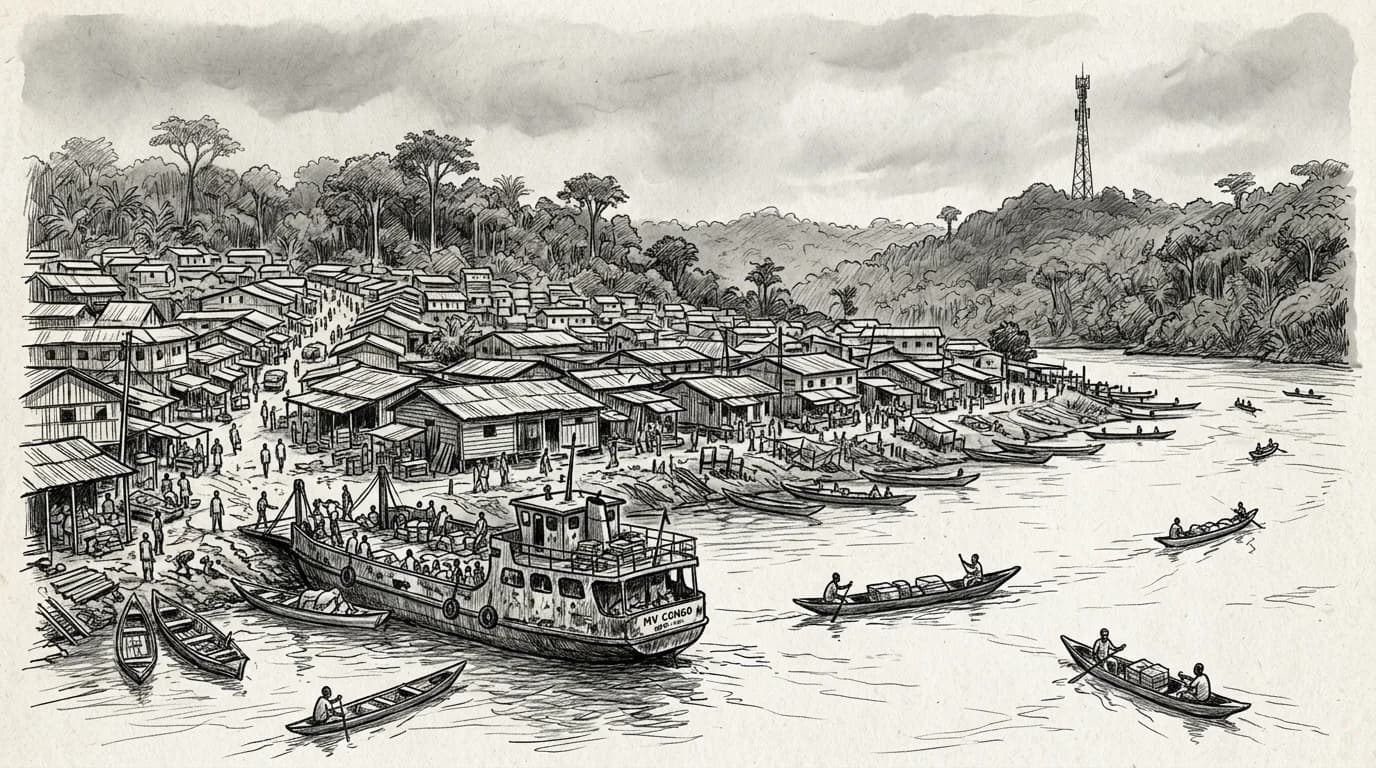
Which networks actually reach Kinshasa, Goma, and Lubumbashi
Three carriers divide the DRC's urban signal between them, and none covers the country evenly. Vodacom DRC holds the largest share of Kinshasa's 4G grid — expect consistent LTE along Boulevard du 30 Juin and the Gombe business district. Airtel DRC runs a competitive 4G layer in Lubumbashi, the copper-belt city where most mining executives base themselves, and its 3G fallback reaches farther into Katanga province than the other two. Orange DRC is the third player: reliable inside Goma's city center but prone to congestion near the Rubaya road corridor, where humanitarian traffic spikes after each displacement event.
Median mobile download speeds across all three networks sit at roughly 8–12 Mbps in urban cores, dropping to sub-2 Mbps in peri-urban zones (Ookla Speedtest Intelligence — DRC 2024). Outside the three anchor cities, signal is patchy at best and absent at worst.
Practical rule: If your assignment takes you between Kinshasa and Goma, verify which MNO your eSIM for Democratic Republic of Congo travel routes through — Vodacom is the safer default for the capital; Airtel outperforms in the southeast.
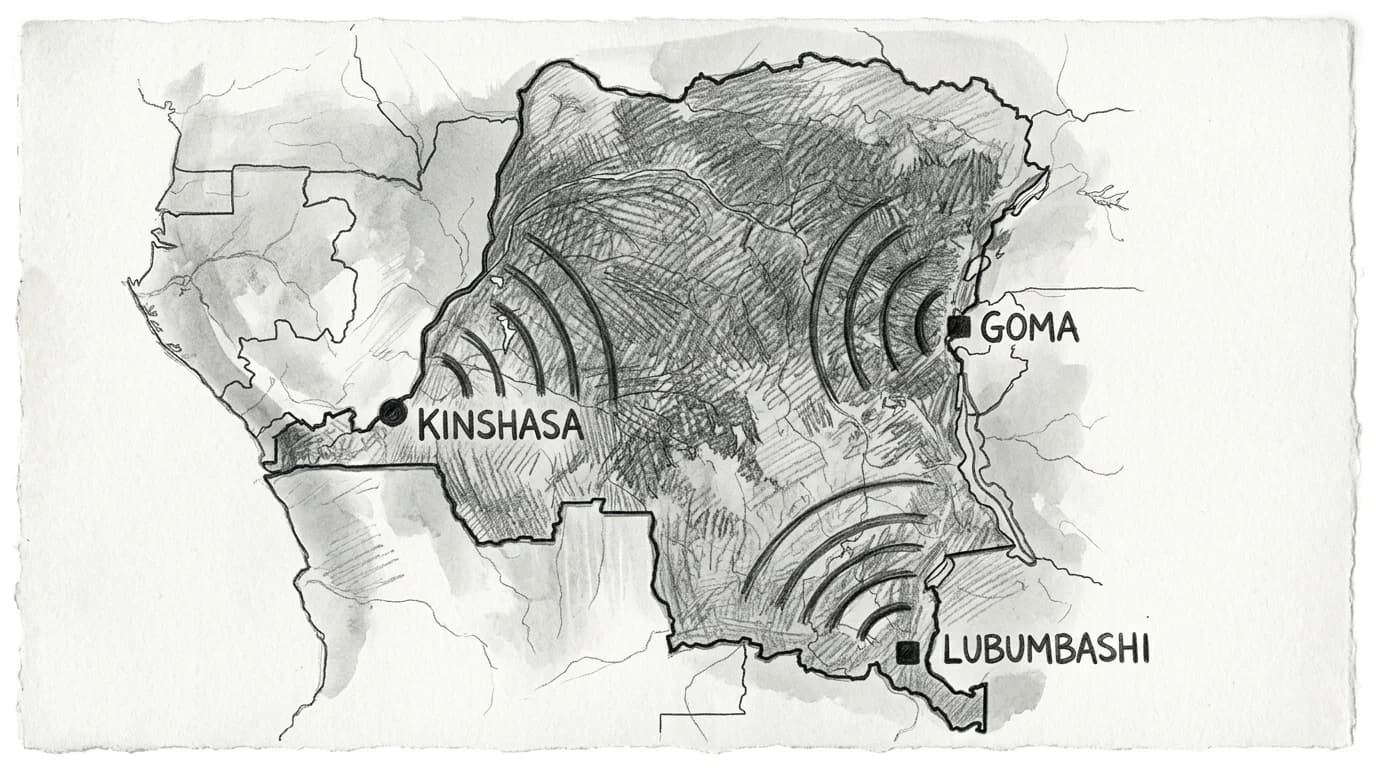
Practical rule: If your itinerary includes Goma but not Lubumbashi, prioritise an Airtel DRC-hosted plan over Orange — Airtel's 4G LTE footprint covers Goma's city centre and the Rwandan border crossing at Gisenyi, where Orange's signal drops to EDGE or disappears entirely.
How to install and activate your eSIM before the flight
N'Djili Airport has no reliable public Wi-Fi — the terminals are patchy at best, and you do not want to discover that on arrival at midnight. Install your eSIM at home, on your own network, at least 24 hours before departure.
The process takes under three minutes on most devices: scan the QR code Roamfly emails you, follow your phone's carrier setup prompts, then leave the eSIM toggled off until you board. Do not activate it early — activation starts the validity clock, and DRC plans are finite. Check that your APN is set correctly before you close the settings screen; on Android, the field sometimes needs a manual entry of the carrier's APN string rather than auto-populating.
Practical rule: Activate mid-flight or the moment wheels touch down at N'Djili — before you join any queue for immigration. You want a working connection for ride apps and hotel confirmation, not after a 40-minute customs hall.
The setup guide walks through both iPhone and Android installs if anything looks unfamiliar.
Before You Fly to the DRC
- Confirm your phone supports eSIM and is carrier-unlocked
- Buy and download your plan on home Wi-Fi
- Screenshot the QR code as a backup
- Toggle the eSIM off until you clear Ndjili Airport
- Save Roamfly's support link offline before departure
Practical rule: Activate your DRC eSIM on your home Wi-Fi before boarding, not at Kinshasa N'Djili Airport — the terminal's public Wi-Fi is unreliable and the QR code scan requires a stable connection. A failed activation on arrival means navigating a foreign SIM kiosk with no data to look up your account.
Managing data across a long DRC assignment
A Kinshasa-to-Kisangani assignment can stretch six weeks — longer than any single DRC eSIM validity window. The practical answer is sequential activation: let your first 30-day package expire, then trigger a second before heading upcountry, so your data clock resets to match the second leg of the trip rather than burning out mid-Lualaba.
Dual-eSIM capability changes the calculus on rough corridors. Between Bukavu and Goma, coverage drops to 2G pockets; between Goma and Kisangani, there are stretches with nothing. Carry a local Vodacom Congo SIM in your physical slot for voice and emergency data while your eSIM handles the bulk traffic where Airtel's 4G signal holds. Your phone's active-data toggle lets you switch in seconds without pulling hardware.
Top-ups work remotely through Roamfly's data top-up portal — useful when you're in Lubumbashi with no reseller nearby. Download offline maps for every named city before leaving Kinshasa. Data dead zones don't warn you; the road to Mbuji-Mayi does not.

eSIM vs Local SIM in the DRC
| Factor | Roamfly eSIM | Local SIM (Kinshasa) |
|---|---|---|
| Setup location | Home, before departure | Airport or street vendor, DRC |
| Language barrier | French and Lingala | |
| Keeps home number | (dual-SIM) | |
| Coverage outside Kinshasa | Partner network roaming | Varies by carrier |
| Top-ups | In-app, instant | Cash, local recharge points |
Get connected before you leave
Ready to buy before your logistics window closes. Roamfly's DRC eSIM delivers to your device in under five minutes — no courier, no airport kiosk queue, no local SIM hunt on Blvd du 30 Juin.
The plan covers 30 days of data, enough runway for most assignments and extended itineraries. Activate the moment your flight lands at N'djili; the network handshake completes before you reach passport control, and you'll have a working connection when the driver asks for your location pin.
DRC logistics punish gaps. A dead phone at the Kasumbalesa border crossing or the Goma ferry pier is not an inconvenience — it's a security risk. Sorting your data before departure removes one variable from a trip that already has too many.
Ready to get connected? Roamfly's DRC eSIM ships to your device in under 5 minutes.
Ready to get connected? Roamfly's democratic eSIM ships in under 5 minutes.
Frequently asked questions
Does my eSIM work in the DRC if my home carrier doesn't have a roaming agreement there?
Yes. A Roamfly eSIM bypasses your home carrier entirely — it connects directly to a local host network (Airtel Congo or Vodacom DRC) via a roaming partnership Roamfly maintains independently. Your home carrier's coverage map is irrelevant. The eSIM appears as a second line on your phone, completely separate from your domestic SIM.
Which cities in the DRC have reliable 4G LTE coverage?
Kinshasa, Lubumbashi, Goma, Bukavu, and Mbuji-Mayi have functional 4G LTE through Vodacom DRC and Airtel Congo. Outside those urban centers, coverage drops to 3G or EDGE on most networks. Rural corridors — including large stretches of Kasai and Équateur provinces — have no mobile signal at all.
Can I use an eSIM near Goma and the Rwanda border in eastern DRC?
Goma city itself has 4G LTE coverage through Airtel Congo, but the signal is intermittent and degrades rapidly outside the urban perimeter. The proximity to Rwanda means your phone may auto-latch onto Rwandan towers (MTN Rwanda, Airtel Rwanda) near Gisenyi — check that data roaming is locked to your DRC eSIM's host network in your phone's carrier settings to avoid unexpected charges.
How do I top up data if I run out mid-assignment in Kinshasa?
Top up through the Roamfly app — the additional data applies to your active eSIM within roughly 60 seconds and does not require scanning a new QR code or reinstalling anything. If the app is unavailable due to low connectivity, top-ups can also be processed via the Roamfly website over any Wi-Fi connection, including hotel or office networks.
Is there any 5G coverage in the Democratic Republic of Congo?
No commercial 5G network operates in the DRC as of 2025. Vodacom DRC and Airtel Congo both run 4G LTE infrastructure in major cities, with 3G filling secondary towns. The GSMA's Sub-Saharan Africa connectivity reports place DRC among the last markets expected to see 5G deployment, with no confirmed rollout timeline published by either operator (GSMA Mobile Economy Sub-Saharan Africa 2024).