
Planning a Bolivia trip? This eSIM for Bolivia travel guide covers network coverage, real prices, and how to activate before you reach 3,600 m altitude.
Bolivian carriers require a national ID (Cédula de Identidad) or a locally-registered foreign document to activate any physical SIM — a rule GSMA's Mobile Economy Latin America 2024 report flags as one of the region's stricter registration regimes (GSMA Mobile Economy Latin America 2024). At the El Alto airport kiosk, that means a queue, a form, and a clerk who may not speak English. If your document doesn't match Bolivia's validation system exactly, the SIM stays locked.
The coverage problem compounds it. Tigo and Entel — the two dominant carriers — both have dead zones across the Altiplano, the Yungas road descent, and most of the Beni department. You can buy a functioning card in Santa Cruz and lose signal entirely by the time you reach Uyuni.
An eSIM sidesteps registration entirely. Your plan activates on your device before you clear customs at El Alto, with no paperwork, no kiosk lottery, and no physical card to lose in a hostel laundry bag. The comparison between eSIM and physical SIM for travel breaks down exactly where each option earns its cost.

Network coverage across Bolivia's wildest terrain
Bolivia runs on three carriers: Tigo, Entel, and Viva. Entel dominates rural reach — its network extends to Uyuni town and patchwork stretches of the salt flat itself, though signal drops to EDGE or nothing once you're 15 km into the white. Tigo holds the stronger hand in Sucre and Potosí's centro histórico, while Viva fills urban gaps in Santa Cruz and Cochabamba but rarely ventures beyond them.
The Yungas Road — Bolivia's most notorious descent — is a signal graveyard between Cotapata and Yolosa. Altitude compounds the problem everywhere above 4,000 m: El Alto airport sits at 4,061 m and tests even Entel's macro grid at the margins. Bolivia's median LTE download speed sits at 18.3 Mbps nationally, against a 4G availability rate of roughly 74% (Ookla Speedtest Intelligence Bolivia 2024).
Practical rule: Download offline maps and your accommodation addresses before you leave La Paz. Above 4,200 m on the Altiplano, assume no data — plan accordingly, not optimistically.
If your eSIM loses signal mid-route, the no-connection troubleshooting guide covers manual APN resets and network-mode switching step by step.
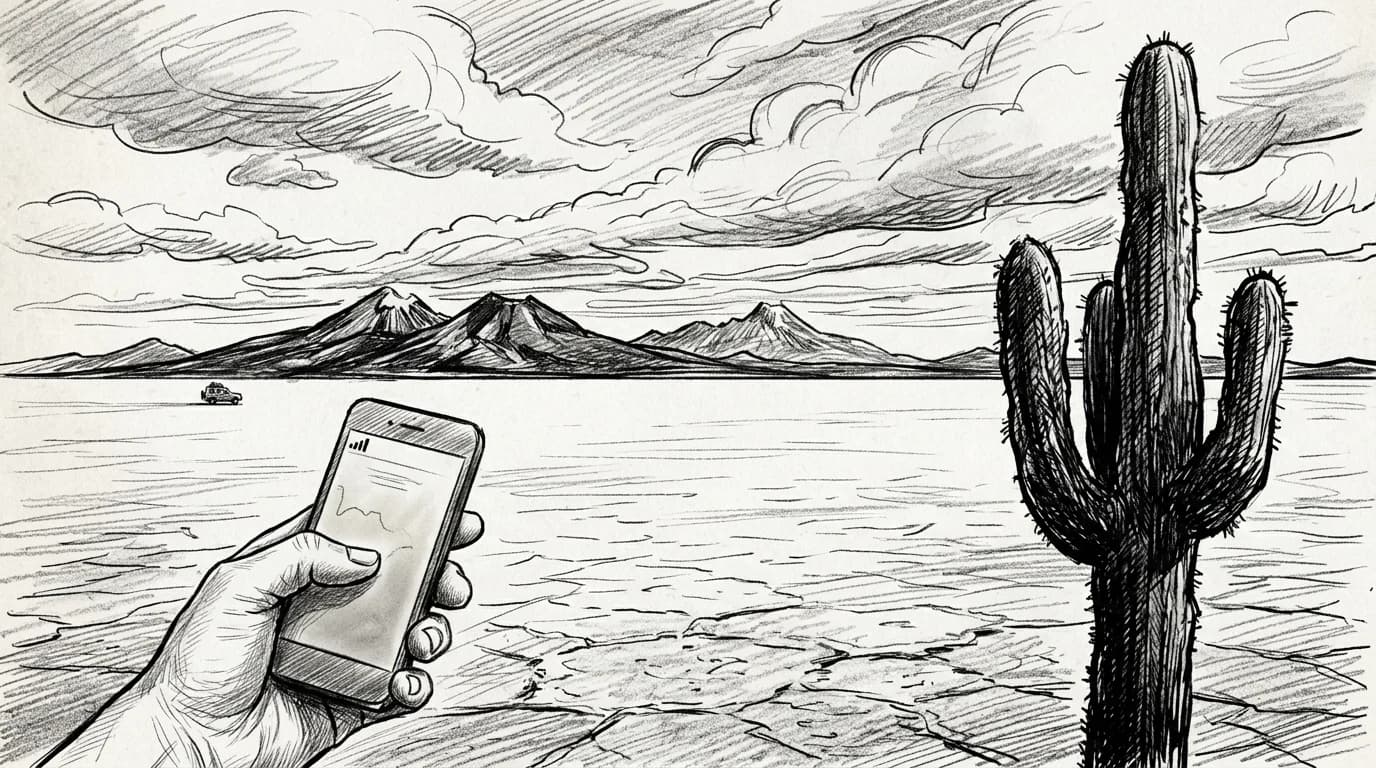
Practical rule: On routes above 4,000 m — think the Altiplano between Uyuni and Potosí — Entel's national backbone outperforms Tigo and Viva. If your itinerary spends more than two days at altitude, confirm your eSIM's host carrier routes through Entel before you buy.
How to choose the right Bolivia eSIM plan for your trip
Three trips, three completely different answers. A four-day Salar de Uyuni loop out of Tupiza burns maybe 1.5 GB — maps offline, a few hostel check-ins, the odd WhatsApp voice note to confirm your jeep pickup. A three-week Andean circuit threading Sucre, Potosí, Oruro, and Lake Titicaca needs closer to 5–7 GB, especially if you're navigating rural legs where you'll lean on Google Maps more than any printed guide. A full month of remote work in Sucre or Cochabamba — stable enough cities for coworking — pushes past 10 GB fast once video calls enter the picture.
Validity matters as much as data volume. Many short-validity packages expire before a slow Bolivian itinerary finishes, so match the validity window to your exit date, not your arrival date.
Practical rule: If your Bolivia leg connects onward to Argentina or Brazil, buy those legs separately — a single regional Latin America plan rarely prices out cheaper than stacking two country plans for trips under 30 days.
For a deeper comparison of plan structures across the region, Roamfly's prepaid eSIM comparison guide breaks down how to read validity fine print before you commit.
Before you fly to Bolivia
- Confirm your phone is unlocked and eSIM-compatible
- Buy your Bolivia plan on home Wi-Fi
- Download the eSIM profile before boarding
- Keep your home SIM active for dual-SIM calls
- Toggle the Bolivia eSIM on after landing at El Alto
Practical rule: A 7-day, 5 GB plan covers a standard Salar de Uyuni loop with data to spare. The math shifts at three weeks: a 30-day plan in Sucre or Cochabamba works out to roughly half the per-GB cost of stacking two shorter packages.
Installing your eSIM before you land in El Alto
El Alto International sits at 4,061 metres — the world's highest commercial airport — and its indoor signal is patchy enough that even locals restart their phones after landing. Trying to scan a QR code on shaky airport Wi-Fi while your body adjusts to the altitude is a bad plan.
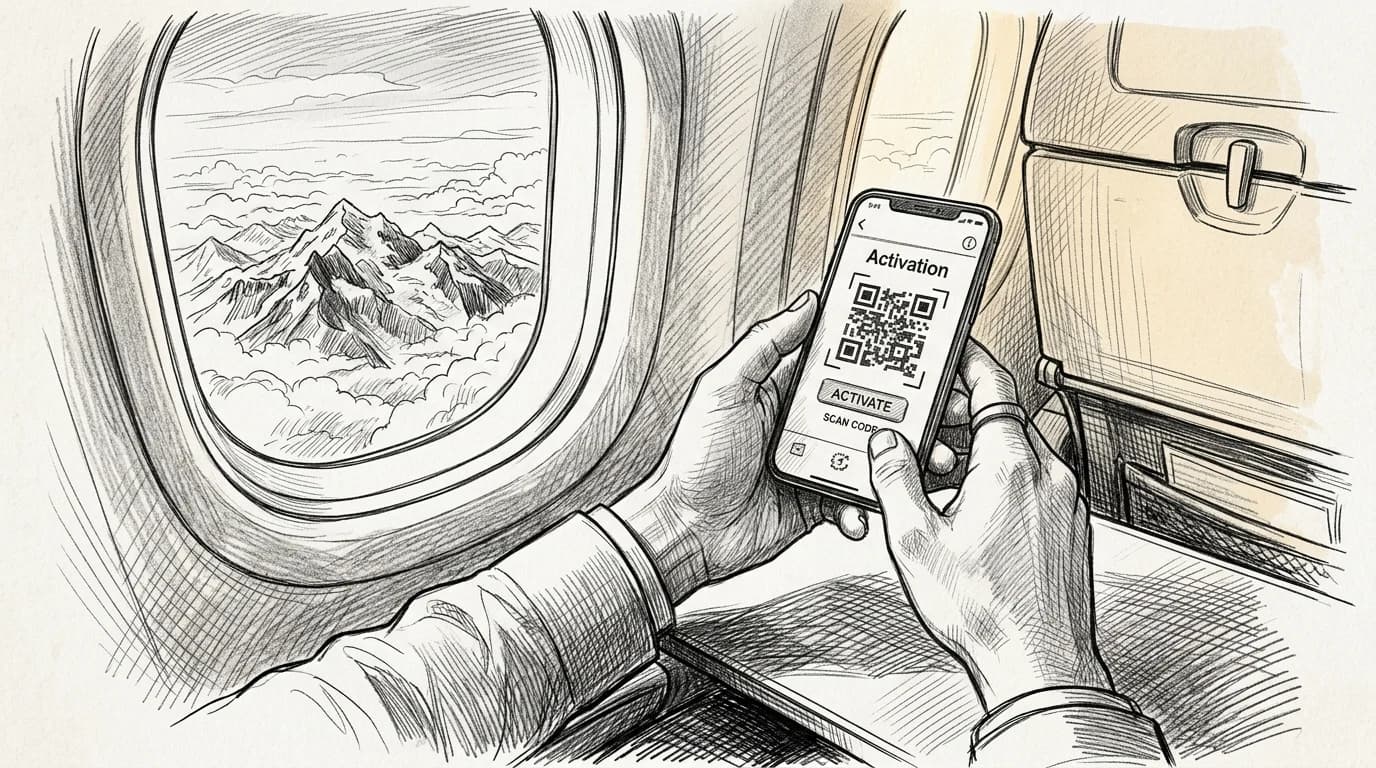
Install at home, or trigger the download during the flight on the airline's Wi-Fi. The actual activation — when your eSIM switches from dormant to live — can wait until you land, but the download must happen while you have a stable connection. Follow Roamfly's manual install guide if your carrier email link opens a QR code you can't self-scan on the same device; it walks you through entering the SM-DP+ address by hand in under three minutes.
Apple's own documentation confirms that eSIM profiles download over Wi-Fi or cellular and don't require a physical SIM to be present (Apple Support eSIM setup). Android follows the same logic through the carrier app or Settings. Either way, you want the profile sitting on your device before the wheels touch the Altiplano.
Bolivia eSIM vs local SIM card
| Factor | Roamfly eSIM | Bolivian Local SIM |
|---|---|---|
| Setup time | 2 minutes, before you fly | 30–60 min at a La Paz shop |
| Passport registration | required by law | |
| Keeps your number | (dual-SIM) | |
| Coverage source | Tigo or Entel roaming | Tigo or Entel direct |
| Top-ups abroad | In-app, instant | Find a store, Spanish required |
Get connected before you leave for Bolivia
Ready to get connected? Roamfly's Bolivia eSIM ships in under 5 minutes.
El Alto Airport sits at 4,061 meters. The last thing you want at that altitude is hunting for a SIM kiosk while your lungs argue with the air. Buy before you board, install on the couch, and land with a working number.
Roamfly's Bolivia plan covers Entel's nationwide grid — the same network that reaches Uyuni, Rurrenabaque, and the Lake Titicaca shore roads that other carriers skip. Activation takes three taps. Your phone shows signal before the crew finishes the safety demo.
The Bolivia eSIM page lists every available package with exact GB, validity, and price. Pick the size that matches your itinerary, check out, and the QR code hits your inbox in minutes. No post office. No airport queue. No SIM tray tool you forgot to pack.
Ready to get connected? Roamfly's bolivia eSIM ships in under 5 minutes.
Frequently asked questions
Which phones support eSIM in Bolivia?
iPhones from XR (2018) onward, every Google Pixel from 4 onward, and Samsung Galaxy S20+ flagships all support eSIM. To confirm yours, go to Settings → General → About → Available SIM on iPhone, or Settings → Network & Internet → SIMs on Android. If you see a slot labeled eSIM or Digital SIM, you're ready.
Can I activate a Bolivia eSIM after I've already landed?
Yes, but you'll need a Wi-Fi connection to complete the download — El Alto International Airport has free terminal Wi-Fi, and most La Paz hotels do too. Activating before departure is faster: scan the QR at home, the eSIM sits dormant on your phone, then connects automatically once you disable airplane mode in Bolivia.
Does eSIM data work on the Salar de Uyuni or in the Altiplano?
Signal is thin across the Altiplano. Tigo Bolivia, the primary host network for most Bolivia eSIM plans, maintains 2G–3G coverage along the main Uyuni access roads and in the town of Uyuni itself, but the salt flat's interior is a dead zone. Download offline maps via Maps.me or Google Maps before you leave Uyuni town.
What happens if I run out of data mid-trip in Bolivia?
Top-up availability depends on your provider. Roamfly top-ups apply within 60 seconds through the app and extend validity if your active plan hasn't expired — no new QR scan required. Buy more data before heading into low-coverage areas like the Yungas road or the Reserva Eduardo Avaroa, where you won't have a connection to process the top-up.
Will the same Bolivia eSIM work when I cross into Argentina or Brazil?
Standard Bolivia-only plans do not extend roaming into Argentina or Brazil. If your itinerary crosses those borders — for instance, entering Argentina from Villazón or Brazil from Puerto Suárez — you need either a regional South America eSIM plan from the start or a separate country eSIM for each destination. Check plan details before you buy.