
Does an eSIM work in multiple countries at once? Here's exactly how multi-country eSIMs work, what limits them, and which plan type fits your trip.
One eSIM can cover a 14-country Europe trip, a two-stop Southeast Asia run, or a single city — it depends entirely on which plan type you load. The question isn't whether eSIM technology supports multiple countries (it does ), but whether the *plan* attached to your eSIM does.
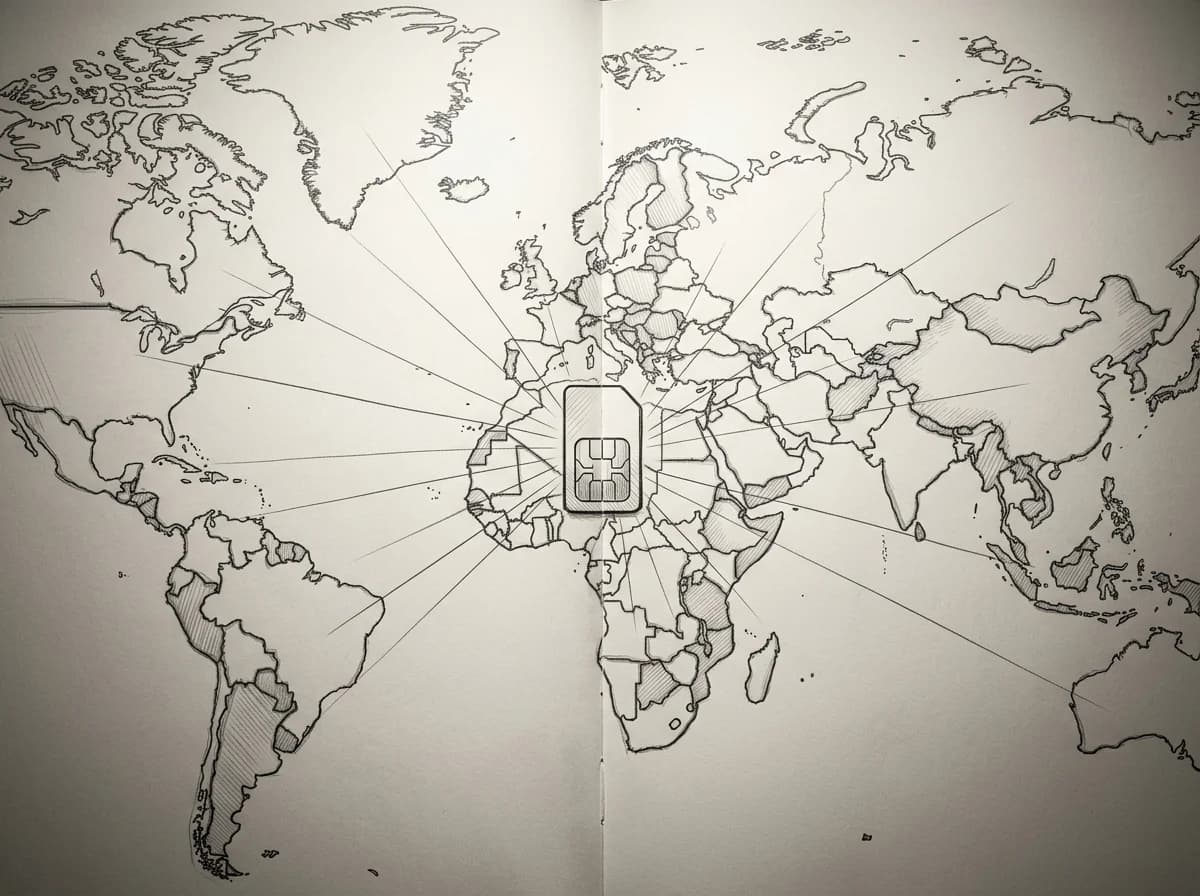
Three architectures exist. A single-country plan ties you to one network — buy a Spain plan, it stops working at the French border. A regional plan bundles a defined country list under one profile, so the same eSIM hands off from Madrid to Lisbon to Rome without you touching a setting. A global plan extends that logic further, sometimes covering 100+ countries on a single data pool.
The catch: "regional" and "global" labels aren't standardized, so two plans with the same name can cover very different country lists. Before you buy, check the exact country roster — not the marketing headline. Managing multiple profiles gets easier once you understand how eSIM switching works on your device.
Single-country vs regional vs global eSIM plans
Three architectures, three very different travel realities.
A single-country plan — like Roamfly's 7-day UAE eSIM — locks your data to one operator's network. Cross from Dubai into Oman and it stops working entirely. No roaming fallback, no grace zone. The plan covers exactly the country named on the label.
Regional plans pool multiple countries under one profile using shared IMSI ranges, so the same eSIM that connects you in Paris also picks up a local operator in Prague or Lisbon without you touching a setting (GSMA's eSIM whitepaper on multi-IMSI and regional roaming architectures). Europe bundles are the most common example — typically 30+ countries on a single data allowance. Global plans extend that logic worldwide, sometimes 100+ destinations, though the per-GB cost climbs sharply and rural coverage is patchier.
Practical rule: If your itinerary crosses even one border, skip the single-country plan. The €2–3 you save rarely covers the hassle of buying a second eSIM at a foreign airport.
Single-country wins for long stays in one place. Regional wins for multi-stop trips. Global wins when your routing is genuinely unpredictable.

Practical rule: If your trip touches more than one country, check the plan's country list before you buy — not after. A single-country UAE plan bought for a Dubai layover will go dark the moment your connecting flight lands in Doha.
How your phone switches networks when you cross a border
The eSIM profile on your device doesn't move. What moves is the radio connection underneath it.
When you land in, say, Frankfurt after a flight from Seoul, your phone scans for available towers, finds a local carrier — say, Deutsche Telekom or Vodafone Germany — and negotiates access through your MVNO's roaming agreement, all within about 90 seconds. The profile itself is a credential, not a SIM card physically swapped between countries. It just sits there while the device does the handshake work automatically.
This matters because the phrase "does an eSIM work in multiple countries at once" has a specific answer: the profile is always singular and stable, but the underlying carrier connection changes at every border. By 2024, over 2 billion activated eSIM connections relied on exactly this architecture (Counterpoint Research eSIM device adoption tracker 2024). Your job is to confirm your plan's roaming list before you travel — not to manage the handoff itself. The phone handles that without prompting.
Three eSIM plan types compared
| Factor | Single-Country | Regional | Global |
|---|---|---|---|
| Countries covered | 1 | Up to 30+ | 150+ |
| Best for | One-destination trips | Multi-stop regional tours | Worldwide itineraries |
| Network switching | Fixed to one country | Auto-switches at borders | Auto-switches at borders |
| Typical validity | 7–30 days | 15–30 days | 30+ days |
| Data pooling | Single country only | Shared across region | Shared globally |
Stacking multiple eSIMs on one device
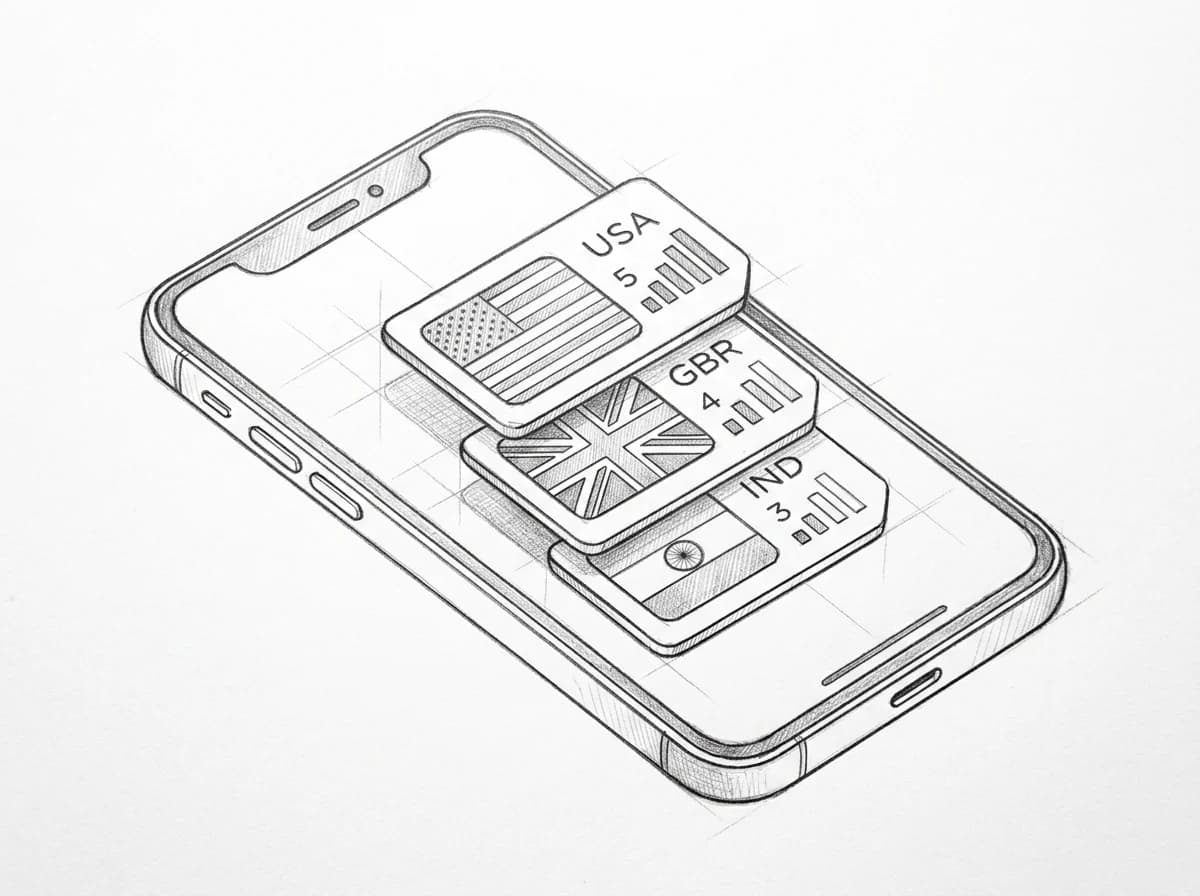
Most flagship phones — iPhone 15, Samsung Galaxy S24, Pixel 9 — can store between 5 and 15 eSIM profiles simultaneously (Apple Support: Use Dual SIM with two eSIMs), though only one profile is active per line at a time. Stacking is exactly what it sounds like: you load a Seoul plan before departure, add a Dubai plan the night before your layover, then switch profiles at the gate.
That workflow earns its complexity on two-leg trips with wildly different coverage needs. A South Korea plan for a week in Seoul, then a UAE plan for three days in Dubai, costs less than a global plan priced to cover both markets. Roamfly's South Korea 7-day eSIM is a clean example of what a tight single-country option looks like.
Practical rule: If your trip spans two regions with a clear midpoint — not three scattered stops — stack two country plans. Three or more destinations, reach for a regional plan instead. The switching overhead compounds fast.
Regional wins on simplicity every time the itinerary gets messy.
Pick the right multi-country plan
- List every country your itinerary touches
- Check each plan's validity against your total trip length
- Confirm 5G or LTE coverage in your key destinations
- Stack a local eSIM for any country with weak regional coverage
- Verify your phone supports multiple eSIM profiles simultaneously
Practical rule: Stack individual country eSIMs only when your itinerary has exactly two stops with a clear break between them. Three or more destinations and a regional plan almost always costs less per GB and saves you the manual-switch headache at every border.
Get connected before you leave
Activation takes under five minutes — less time than the average airport security queue. If your itinerary crosses three or more countries, a regional plan removes every manual-switching decision the stacking section just described.
Roamfly carries regional plans covering Europe (40+ countries), Southeast Asia, and the Americas, alongside single-country options for tighter trips. Browse, purchase, and receive your QR code before you board. The install guide walks you through scanning it on both iPhone and Android, so you land ready rather than hunting for airport Wi-Fi.
Ready to get connected? Roamfly's multi-country eSIM plans ship in under 5 minutes — compare regional and global options and pick the one that matches your exact itinerary.
One rule of thumb carries from everything above: buy before departure, activate on landing, and let the plan handle the borders. Your phone will.
Frequently asked questions
Can I use one eSIM in both Europe and Asia on the same trip?
Not with a single regional plan — European eSIMs typically cover 30–40 countries across the EU and EEA, while Asia plans cover a separate set of markets like Japan, South Korea, and Thailand. For a trip spanning both regions, stack two eSIMs: one regional plan per continent. Most iPhones from XR onward and Pixels from 4 onward support this (Google Support: Use eSIM on Pixel phones).
Does a regional eSIM automatically connect when I land in a new country?
Yes, if that country is listed in your plan. The eSIM scans for partner carrier signals the moment airplane mode switches off and latches onto the strongest available host network — no manual APN changes required. Connection usually completes within 60 seconds of landing.
What happens to my data balance when I cross a border mid-plan?
Your remaining balance carries with you across every country covered by the plan. A 10 GB regional Europe eSIM doesn't reset at the French-German border — you draw from the same pool throughout. The plan validity clock (typically 15 or 30 days) also keeps running regardless of how many countries you visit.
Will my eSIM work if I transit through a country not listed in my plan?
No data service in that country, but your eSIM profile stays intact and reactivates automatically the moment you land in a covered destination. If the layover is long enough to matter — say, 6+ hours in Dubai on an Asia plan that excludes the UAE — add a short single-country plan for that stop rather than upgrading your whole package.
Can I have two eSIMs active at the same time on my phone?
Most dual-SIM devices — iPhone XS onward, Google Pixel 4 onward, Samsung Galaxy S20+ (Samsung Support: eSIM compatible Galaxy devices) — can store multiple eSIM profiles but only activate one at a time for data. You can keep a second eSIM installed and switch in Settings in under 30 seconds, no QR re-scan needed. Check Settings → Cellular (iOS) or Network & Internet → SIMs (Android) to manage profiles.