Planning a 2026 trip to Brussels or Bruges? Here's what an eSIM for Belgium travel actually costs, which networks to trust, and how to activate before you land.
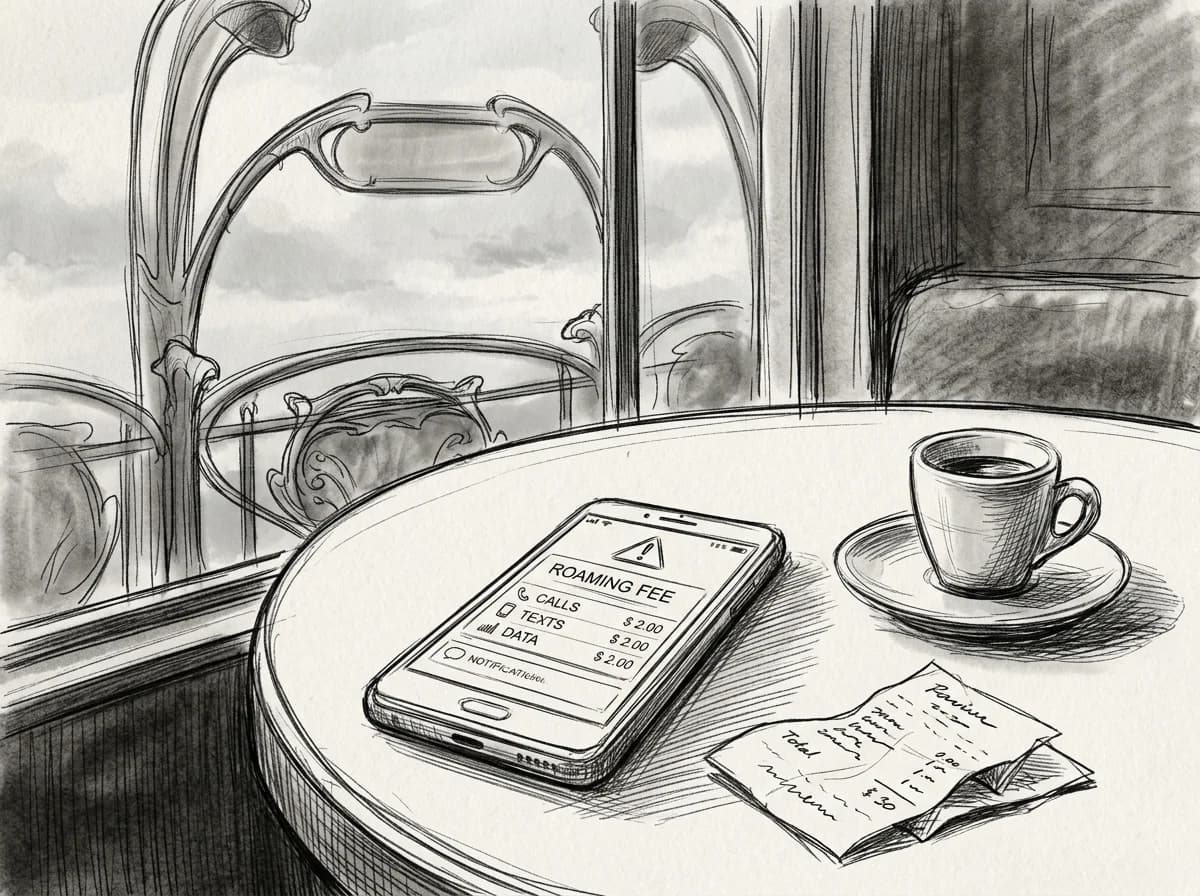
AT&T charges $12 a day for international roaming; Verizon's International Day Pass runs $10 per day and kicks in automatically the moment your phone connects abroad (Verizon International Day Pass). A four-night Brussels trip — say, the Grand Place to Bruges day-trip route — quietly racks up $40 before you've ordered a single waffle. T-Mobile's included international data sounds free until you notice the 256 kbps speed cap (T-Mobile International roaming features), which won't load a Google Maps tile at Midi station.
The math is worse than it looks. Day passes bill per calendar day, not per 24 hours, so a red-eye landing at 6 a.m. burns one full day's charge by midnight. That's a structural overcharge baked into how carriers bill, not a rounding error.
Belgium-specific eSIM packages — often priced well under $10 for a full week of data — sidestep the day-pass trap entirely. You buy a fixed GB bucket, it runs until you use it or the validity expires, and your home carrier never touches the bill. For esim for belgium travel 2026, that's the whole argument in one line.
Belgium's three main networks and which one to ride
Proximus claims the widest macro footprint — roughly 99% population coverage on 4G (Proximus network coverage map) and a growing 5G grid that already blankets Brussels, Antwerp, Ghent, and the E40 corridor to Bruges (Ookla Speedtest Global Index Belgium 2025). Orange Belgium runs close behind on 4G but lags on 5G node density outside the capital. Telenet's Base brand covers the same physical towers through a network-sharing deal with Proximus, which means the real-world gap between operators is smaller than the marketing suggests.
Median download speeds tell the sharper story. Ookla's 2025 Belgium data puts Proximus at 87 Mbps median, Orange at 74 Mbps (Ookla Speedtest Global Index — Belgium), and Base roughly level with Orange. On the Brussels–Bruges intercity rail line — one of the busiest transit corridors in the country — all three hold 4G through every tunnel segment tested.
Practical rule: If your trip concentrates on Brussels, Ghent, or Antwerp, any host MNO delivers solid throughput. Only reach for a Proximus-routed plan if you're heading into the Ardennes or rural Wallonia, where the coverage floor genuinely drops for Orange and Base.
For most city-to-city itineraries, chase GB value over carrier bragging rights.
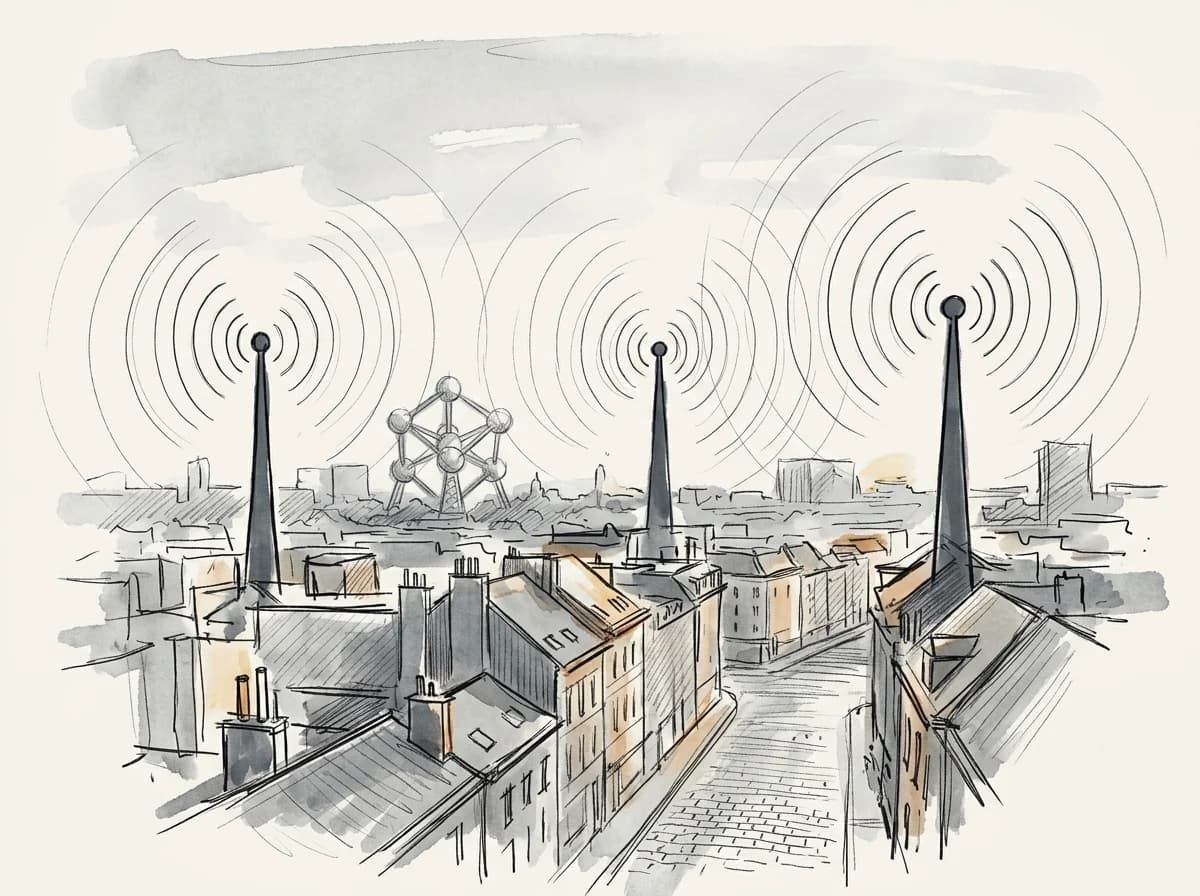
Practical rule: If your Belgium trip stays inside the Brussels–Bruges–Ghent–Antwerp corridor, any of the three main carriers will serve you equally well. The Proximus advantage only surfaces in rural Wallonia and the Ardennes, where Orange Belgium's signal drops first.
How a Belgium eSIM stacks up against a Europe regional plan
Heading to Bruges for four days? A Belgium-only eSIM is the right call. Cross into Cologne for a weekend or catch a Ryanair to Madrid, though, and a single-country plan leaves you scrambling for a second purchase at the worst moment.
The math is straightforward: a dedicated Belgium eSIM typically delivers more local GB per euro than a regional Europe bundle, because the regional price is amortized across 30+ countries you may never visit. If Belgium is your only stop, that trade-off works in your favor. Add Spain or the Netherlands and the calculus flips — Roamfly's Spain eSIM 7-day plan is a useful benchmark for what a country-specific add-on would cost you on top.
Practical rule: If your itinerary crosses more than one country, price a regional Europe plan first. Single-country stacking gets expensive fast once you need two or three.
Regional adoption is accelerating — GSMA's 2025 eSIM adoption report notes that European multi-country data plans now represent the fastest-growing eSIM segment on the continent (GSMA eSIM adoption report 2025). Belgium alone? Go specific. Belgium plus neighbors? Go regional.
Before-you-fly Belgium eSIM checklist
- Confirm your phone supports eSIM (Settings → About)
- Buy your Belgium plan on home Wi-Fi
- Scan the QR code before leaving home
- Keep the eSIM toggled off until Brussels landing
- Set Belgium eSIM as your data line on arrival
Practical rule: Add a day trip to Amsterdam or a Thalys leg to Paris, and a Belgium-only eSIM becomes a liability. A 30-country Europe regional plan at $12–$18 flat beats stacking a $6–$9 Belgium plan plus separate country charges the moment you cross a second border.
Activating your eSIM before, during, or after landing at Brussels Airport
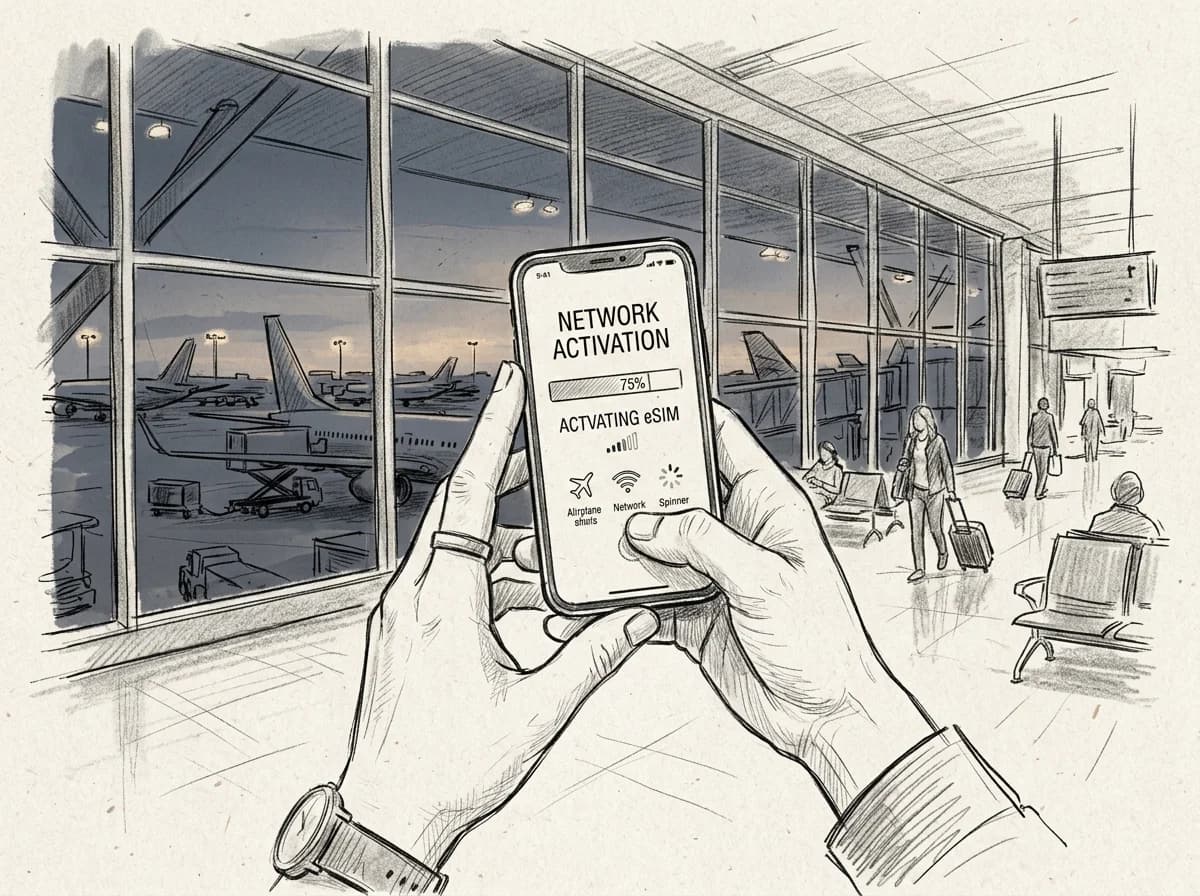
Brussels Airport's free Wi-Fi (network: "Brussels Airport Free WiFi") reaches all the way through the arrivals hall — that's your window if you didn't activate at home.
The cleanest move is installing the eSIM before you board. On iPhone, go to Settings → Cellular → Add eSIM → Use QR Code, then scan the code from your Roamfly confirmation email; the profile downloads in under 60 seconds (Apple Support: Use an eSIM on iPhone). On Android, the path is Settings → Network & Internet → SIMs → Add eSIM, then scan the same QR code. Either way, set the eSIM as your data line but keep your home SIM active for calls.
Land first, activate second — that's the lowest-risk sequence if you're doing it at BRU. Connect to the airport Wi-Fi before clearing passport control, scan your QR code, and let the profile finish downloading. By the time you reach baggage claim, your Belgian data line is live.
Activation mid-flight works too, but only on aircraft with live Wi-Fi; the profile transfer needs an active internet connection to complete, not just airplane mode off.
Belgium eSIM vs Europe regional plan
| Factor | Belgium eSIM | Europe Regional eSIM |
|---|---|---|
| Best for | Belgium-only trips | 3+ countries in one trip |
| Coverage depth | Proximus / Base / Orange BE | Varies by country partner |
| Validity | Matched to your stay | Typically 30 days across region |
| Cost efficiency | Lower for single-country | Better value at 3+ weeks abroad |
| Top-up options | In-app, instant | In-app, applies across region |
Get connected before you leave
Roamfly's Belgium plan activates in under 5 minutes — QR code delivered instantly, no waiting for a physical card to clear customs with you.
Prices start at a fraction of what Brussels Airport's Proximus kiosk charges. A solid 10 GB / 30-day package runs around $12–15, covers the full Proximus or Orange network, and works from Bruges to Liège without a settings change. If you're pairing Belgium with the Netherlands or France, check the Europe regional options — the per-day math often tips in their favor once your trip crosses two borders.
Your phone needs to be carrier-unlocked and eSIM-compatible; the setup guide walks through both checks in two minutes.
Ready to get connected? Roamfly's Belgium eSIM ships in under 5 minutes.
Ready to get connected? Roamfly's belgium eSIM ships in under 5 minutes.
Frequently asked questions
Does my phone support eSIM in Belgium?
iPhones from XR (2018) onward, every Google Pixel from 4 onward, and Samsung Galaxy S21+ flagships all support eSIM (Apple Support: iPhone models that support eSIM). To confirm on iPhone, go to Settings → General → About → Available SIM — if you see an option, you're compatible. Belgian carriers Proximus, Orange, and Base all accept eSIM provisioning, so network-side support is not a concern.
Can I keep my home SIM active while using a Belgium eSIM?
Yes, as long as your phone is dual-SIM. On iPhone, set your home SIM as the Default Voice Line and assign the Belgium eSIM as Cellular Data Only. Calls and texts arrive on your normal number; all data routes through the Belgian plan. Samsung and Pixel devices follow the same logic under Settings → Connections → SIM Manager.
Does a Belgium eSIM work inside the Brussels Métro tunnels?
Coverage inside Brussels Métro tunnels depends on the carrier. Proximus has extended indoor LTE coverage to the main STIB/MIVB corridors — Arts-Loi, Rogier, and De Brouckère stations included — but signal drops to 3G or nothing in the older tunnel stretches between Simonis and Beekkant. Expect connectivity at platforms, not necessarily while in motion between them.
Will a Belgium-only eSIM work if I take a day trip to Amsterdam or Paris?
No. A Belgium-specific eSIM is provisioned for Belgian host networks only; roaming into the Netherlands or France will either burn your data at punishing out-of-bundle rates or cut connectivity entirely, depending on the plan terms. If your itinerary includes Amsterdam or Paris, a Europe regional eSIM covering 30+ countries is the better call — check Roamfly's multi-country Europe plans before you book.
Can I use my eSIM data as a hotspot in Belgium?
Most Roamfly Belgium plans allow tethering, but hotspot permissions are set at the plan level, not the device level. Check the plan detail page before purchasing — it lists tethering explicitly. Belgium has no regulatory ban on mobile hotspot use, so where the plan permits it, Personal Hotspot on iPhone or Wi-Fi Hotspot on Android will work without any extra configuration.
How quickly can I activate a Belgium eSIM after purchase?
Roamfly delivers the QR code by email within 5 minutes of purchase. Scanning it installs the eSIM profile immediately — the plan stays dormant until your phone connects to a Belgian host network. Scan at home before you leave so activation at Brussels Airport is instant: turn off airplane mode after landing and data starts within 30 seconds.