eSIM for business travelers compared by region — Europe, MENA, Asia-Pacific, and the Americas. Real prices, coverage tiers, and which plan type wins per route.
A Frankfurt–Amsterdam–Warsaw sprint in five days used to mean three separate SIM purchases, three activation headaches, and a combined bill that regularly hit $80–$120 for mediocre data on each leg. One regional Europe plan covering all three countries now runs as low as $8.50 for the whole trip.
The stacking problem is time as much as money. Sourcing a local eSIM per country means researching compatible carriers, confirming your device supports the plan, and activating before you lose signal in a new airport terminal — repeat that three times in a week and you've burned an easy 45 minutes of productive travel time. Global business travel is accelerating: GSMA Intelligence's 2025 eSIM adoption report puts eSIM-enabled enterprise devices above 60% of new activations (GSMA Intelligence 2025 eSIM Adoption Report), precisely because IT managers are standardising on regional plans to cut that overhead (GSMA Intelligence 2025 eSIM Adoption Report).
The exception matters. For single-country trips longer than two weeks — or markets like Egypt and Gibraltar where regional plans don't reach — local pricing can undercut a regional bundle. A 10-day unlimited Egypt plan runs $41.50; no Europe-wide package touches Cairo. Knowing when to stack and when to go regional is the whole game, and the sections below run the numbers for every major corridor in eSIM for business travelers worldwide.

Europe: one regional plan covers 40+ countries from $8.50
A London–Frankfurt–Warsaw corridor used to mean three SIM swaps, three top-ups, and three rounds of hunting for a carrier store between meetings. One Europe-wide regional eSIM collapses that to a single activation.
Roamfly's Europe regional plans start at $8.50 and cover 40+ countries on a single profile — the same plan that works on the Eurostar works in the Warsaw Chopin arrivals hall. Western Europe's LTE infrastructure makes this reliable in practice: Ookla's 2025 Global Index puts median LTE download speeds across Western Europe at 58–72 Mbps (Ookla Speedtest Global Index 2025), well above most video-call thresholds.
Practical rule: The UK sits outside EU roaming rules post-Brexit, so a European regional plan may not extend coverage there. If London is on your itinerary, check the UK prepaid data guide before you commit to a regional package — a short GB top-up for Britain often costs less than upgrading the whole plan.
Validity matters more than GB count on a multi-city sprint. A 30-day window on a 10 GB plan clears most week-long European road trips with room to spare.
MENA: where local plans still win — and what Gibraltar and Egypt actually cost
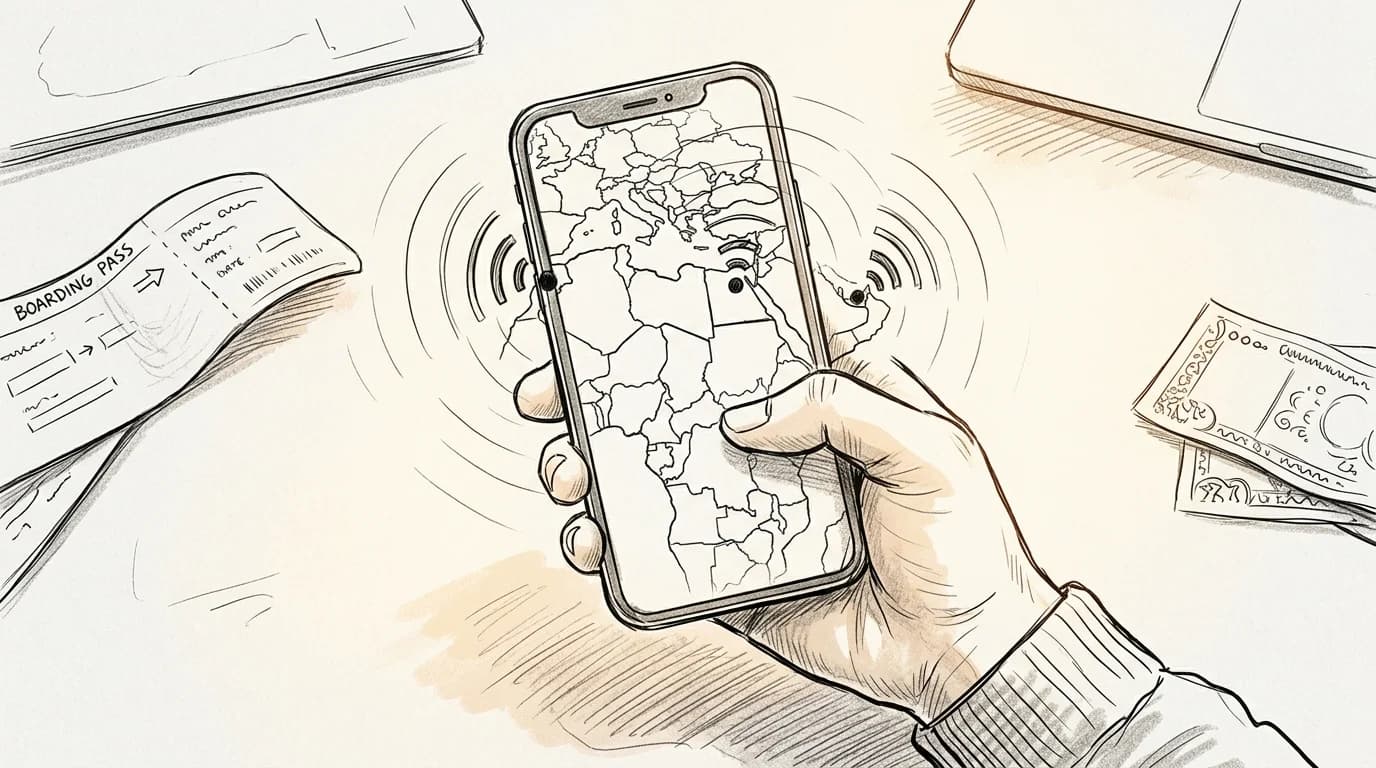
No MENA regional plan covers the whole map cleanly. The Gulf, North Africa, and Mediterranean fringe each operate under different spectrum rules and roaming agreements, which means stacking local plans often beats a single regional package.
Gibraltar is the outlier that surprises road warriors on the Iberian run. It sits outside EU roaming law, so your European plan hits a wall at the Spanish border checkpoint. A dedicated local plan runs $10 for a single day, $27 for three days, or $58 for a full week — reasonable for a one-night stop on a Gibraltar–Algeciras–Seville circuit, but worth building into your itinerary budget explicitly.
Egypt's pricing reflects a different logic: unlimited data for 10 days costs $41.50, scaling to $53.50 for 15 days, and Cairo's 4G grid is solid enough that unlimited tiers make sense rather than rationing gigabytes across meetings in Zamalek or site visits in the New Administrative Capital.
Bahrain punches above its geography as a Gulf transit hub — Emirates and Gulf Air both use Manama as a connection point, and a day's worth of meetings there justifies a dedicated plan rather than burning roaming credits. The Bahrain business travel breakdown covers the Gulf fringe in more detail.
Practical rule: Budget Gibraltar as a day-rate market. One day costs $10; three days costs $27 — so if your layover runs long, upgrading mid-trip is the smarter call.
Regional eSIM vs. Stacked Country Plans
| Factor | Regional eSIM | Stacked Country Plans |
|---|---|---|
| Setup before trip | One QR code, one purchase | One purchase per country |
| Mid-trip switching | Automatic, no action needed | Manual toggle each border |
| Coverage gaps | plan follows you | if you forget to buy |
| Cost predictability | Fixed rate across region | Varies by country |
| Works in transit hubs | (e.g. Dubai, Singapore) | Only if that country is bought |
Asia-Pacific: 5G density and the regional vs. local split
Tokyo–Singapore–Sydney in one week is a common enough sprint that the regional math matters. A Japan-only plan for seven days runs around $12–18 for 10 GB; stack Singapore and Australia on top and you're looking at $40+ in separate purchases, plus three activation windows to manage at three different airports.
A single Asia-Pacific regional eSIM collapses that to one profile, one validity clock. The catch: regional plans typically roam onto secondary carriers rather than the dominant MNO, which shows up on 5G. Ookla's 2025 Asia-Pacific 5G availability index puts Japan at 93% urban availability and Singapore at 89% (Speedtest by Ookla — Global Index 2025), but both drop sharply outside core metro corridors — think Fukuoka over Narita's secondary terminals, or Perth versus Kingsford Smith (Speedtest by Ookla — Asia-Pacific 5G availability index 2025). A local Japan eSIM pins to NTT Docomo or au directly; a regional plan may not.
Practical rule: If your itinerary is Tokyo-only for seven or more days, buy local. Cross two or more APAC countries in under 10 days, regional wins — but confirm the host carrier before you activate. Check how to activate an eSIM on iPhone before traveling so the profile is ready the moment you clear customs.
Before Your Multi-Country Trip
- Check your phone is carrier-unlocked and eSIM-capable
- Map your itinerary — count how many countries in how many days
- Buy a regional plan if crossing 3+ countries in under 21 days
- Install the eSIM profile on home Wi-Fi before departure
- Keep the eSIM toggled off until you clear customs on arrival
- Save the QR code screenshot in case of re-scan
Practical rule: For Asia-Pacific, the regional-vs-local decision hinges on one threshold: three or more cities across different countries tips the math toward a regional plan. A Tokyo-only week on a single-country Japanese eSIM will cost less and deliver faster speeds than splitting bandwidth across a multi-market package.
Americas: fragmented networks and why no single plan dominates
The Americas don't behave like one region. Canada and the US run on mature 5G grids where a single North America eSIM covers most business needs cleanly. Latin America is different — carrier agreements fragment by country, and the T-Mobile partner patchwork means your "regional" plan might hand off to a congested secondary carrier the moment you cross a border.
São Paulo is the sharpest example. Roaming there through a Latin America regional plan often routes through Claro or TIM's wholesale tier, not their primary LTE band, so speeds in Paulista Avenue business hotels run noticeably slower than a local SIM on the same tower. Mexico City gets 5G in Polanco and the airport, but switch to Monterrey or Guadalajara and most regional plans drop to LTE Band 4.
For multi-country LatAm trips — say, Mexico, Colombia, and Brazil in one week — stack a regional plan for Mexico and Colombia, then add a dedicated Brazil plan. Belize sits entirely outside most regional bundles; the Belize travel eSIM guide explains why a local plan is the only real option there.
Practical rule: Never assume a "Latin America" regional plan includes Brazil on equal footing. Read the carrier footnotes; Brazil is frequently listed as a roaming extension, not a primary coverage country.

Get connected before your next trip
Ready to get connected? Roamfly's business travel eSIM catalog covers every region in this guide — Europe, MENA, Asia-Pacific, and the Americas — with plans you can activate before your boarding gate closes.
The right plan depends on where you're landing first. A Frankfurt-to-Dubai-to-Singapore rotation needs a different stack than a single-country sprint to Cairo; a 10-day Egypt plan runs $41.50, Gibraltar starts at $10 for a single day. Match validity to itinerary, not the other way around.
Browse by region, filter by validity and data, and install in under five minutes. Your next trip's coverage shouldn't be the last thing you sort out.
Frequently asked questions
Can I use one eSIM across multiple regions on the same trip?
Not with a single regional plan — each plan is scoped to one region (Europe, Asia-Pacific, MENA, Americas). If your itinerary crosses regions, you need two or more plans loaded on the same device as separate eSIM profiles. Most dual-SIM phones let you switch active data profiles in Settings without deleting either plan.
Are regional eSIMs cheaper than a corporate roaming package?
For most road warriors, yes. Corporate roaming via a home carrier typically runs $10–$15 per day per country. A Roamfly Europe regional plan covering 40+ countries starts at $8.50 for 5 GB with a 30-day validity — a week of heavy use in three countries would cost under $20 versus $100–$210 on a per-diem roaming bolt-on.
Do regional eSIMs support 5G or only LTE?
It depends on the region and host carrier. Roamfly's Europe and Asia-Pacific regional plans include 5G access where the underlying MNO supports it — Tokyo, Seoul, and London corridors, for example. MENA and Americas regional plans are currently LTE-only, with 5G roaming agreements still limited across those networks.
What happens if I run out of data on a regional plan mid-trip?
Top up directly in the Roamfly app — the additional data applies to the same eSIM profile within 60 seconds and extends validity if the original plan is still active. You don't scan a new QR code or reinstall the profile. If the plan has already expired, you'll need to activate a new one.
How do I keep my existing number for calls while using a regional eSIM for data?
Set your physical SIM or home eSIM as the Voice and SMS line, and assign the regional eSIM as the Cellular Data line. On iPhone: Settings → Cellular → choose the regional plan under 'Cellular Data'. On Android: Settings → Network & Internet → SIMs → Preferred SIM for data. Calls and texts route through your home number; all data uses the regional plan.