
Planning Canada travel? Compare eSIM data plans by price, GB, and network coverage — so you're connected from YVR to Banff before you clear customs.
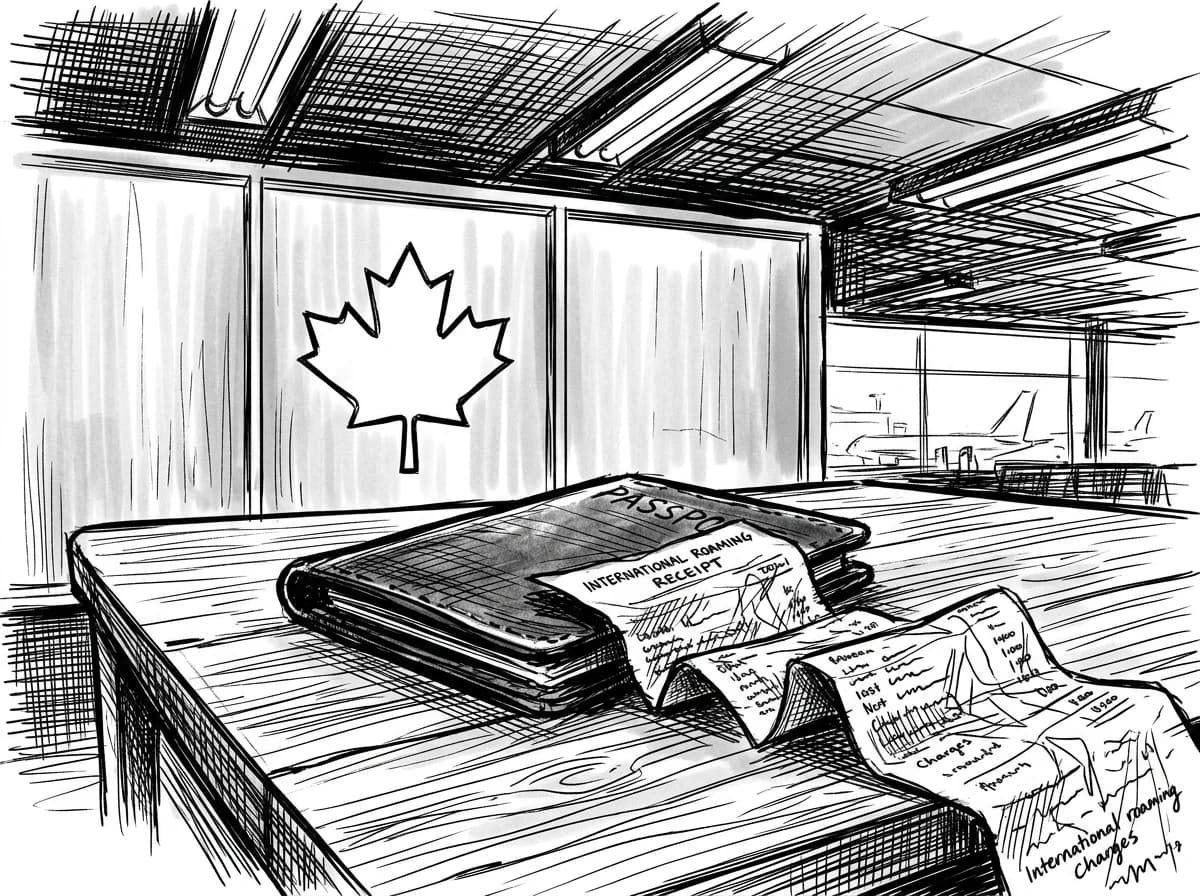
AT&T's International Day Pass runs $12 per day in Canada — that's $84 for a week before you've bought a single coffee on Granville Street. Verizon's equivalent sits at $10/day, and if you forget to add the pass before boarding, per-MB overage rates can hit $0.005/KB, which translates to roughly $5 per megabyte of unmanaged data (T-Mobile's International Day Pass page lists comparable $5/day high-speed caps that throttle to 128 Kbps after 512 MB).
The math is brutal on longer trips. Ten days in Vancouver, Banff, and Quebec City on a major US carrier day-pass: $100–$120, with throttled speeds after the first half-gigabyte each day. A local Canadian eSIM plan covering the same period costs a fraction of that.
Canadian roaming is also one of the traps that catches travelers on 7-day US plans — the coverage boundary at the border cuts your plan dead the moment you cross into British Columbia or Ontario. You need a dedicated Canada plan, full stop.
Canada's three main networks: Rogers, Telus, and Bell
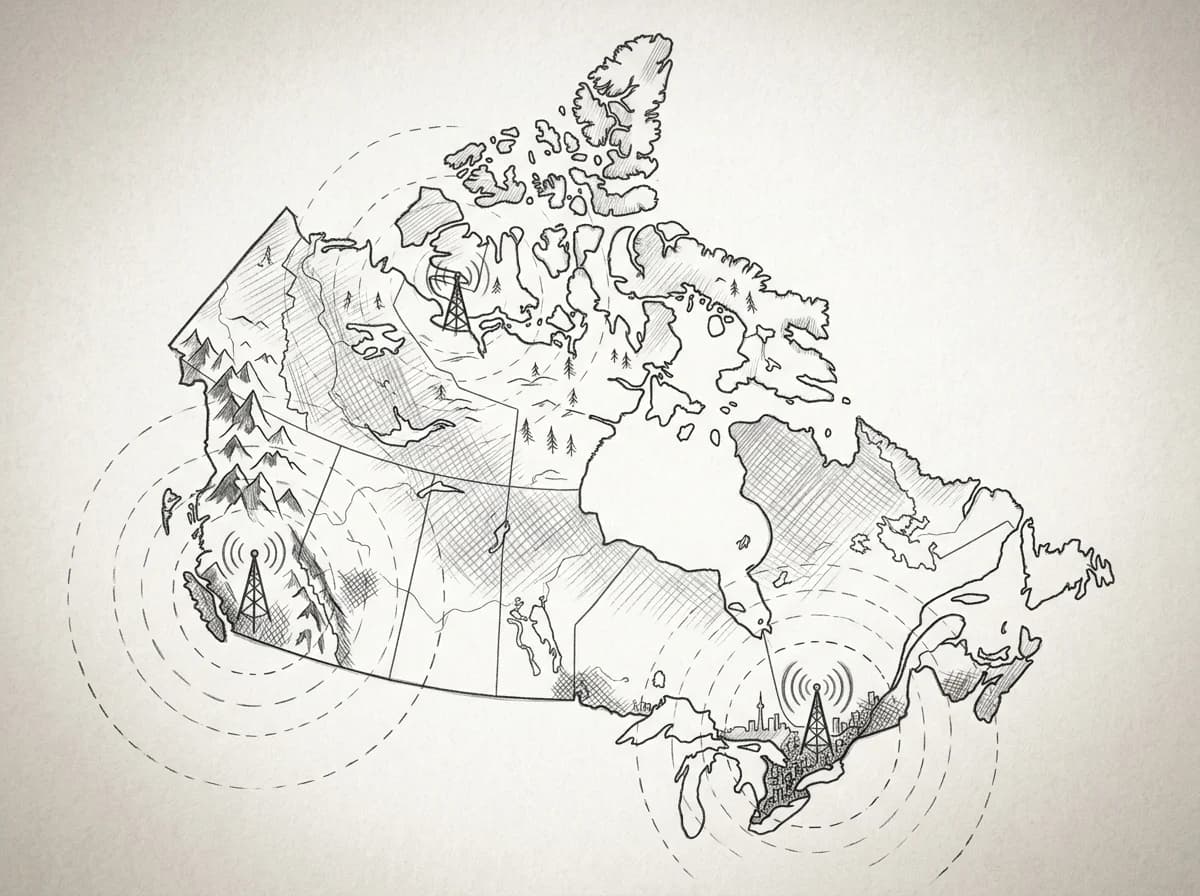
Rogers, Telus, and Bell together control roughly 90% of Canadian wireless revenue (CRTC Communications Monitoring Report 2023). In practice, most eSIM packages sold for Canada roam on one of these three — and the differences matter once you leave the Trans-Canada corridor.
Telus and Bell share a national network agreement, so their combined LTE footprint is the broadest, particularly through rural British Columbia and the Alberta Rockies. Rogers owns its separate grid and dominates urban Ontario and Quebec — Toronto's downtown core, Montreal's métro stations — but thins out noticeably on the Nova Scotia coastline past Antigonish and along northern Ontario's Highway 11.
Practical rule: If your itinerary includes Cape Breton, the Cabot Trail, or anything north of Sudbury, confirm your eSIM roams on Telus or Bell. Rogers-only coverage drops to 3G patches in those corridors.
North of 60° — Yukon, NWT, Nunavut — all three carriers fade. Satellite coverage is the only reliable fallback there, and no standard eSIM plan covers it.
Practical rule: If your itinerary stays within Vancouver, Toronto, Calgary, or Montreal, any Rogers-, Telus-, or Bell-backed eSIM performs identically. The network choice only matters once you're driving the Trans-Canada past Wawa or camping in Gros Morne — where Telus's rural LTE footprint runs about 15% wider than Rogers (Ookla Speedtest Global Index — Canada).
How to pick the right Canada eSIM plan for your trip length
Trip length does most of the work here. A 4-day drive from Buffalo to Niagara Falls and Toronto needs maybe 8–10 GB total; a 30-day cross-country haul from Halifax to Vancouver could burn through 30 GB if you're navigating offline maps and streaming at night.
For short trips — under two weeks, Canada only — a Canada-specific plan wins on price. You're not paying for US coverage you won't use. Longer trips, or anything that crosses the border, flip the math: a North America combo plan covers both sides without swapping profiles at the Peace Arch.
Practical rule: If you'll cross into the US even once — a day trip to Seattle, a quick Niagara run from the American side — go combo. Reactivating a second eSIM mid-trip wastes time and often costs more than the upgrade would have.
The 30-day North America plan is worth comparing directly against any Canada-only option before you commit. A few dollars more often buys genuine flexibility, which matters on a road trip where the border is just a sign on the highway.
Before you fly to Canada
- Confirm your phone is unlocked and eSIM-capable
- Choose a plan that covers Rogers, Telus, or Bell
- Buy your eSIM on home Wi-Fi before departure
- Scan the QR code and download the profile
- Keep the eSIM toggled off until you land
- Activate the moment you clear Canadian customs
Practical rule: If your trip crosses the US-Canada border even once — Niagara Falls, a Vancouver-to-Seattle day run, anything — price a North America combo plan before defaulting to Canada-only. A Canada 15-day plan plus a separate US day-pass often costs $6–$9 more than a single cross-border plan covering the same period.
Is your phone compatible with a Canada eSIM?
Most iPhones from the XS onward support eSIM — that's every model released since late 2018 (Apple eSIM carrier support page). Android is patchier: Google Pixel 3 and later are solid, Samsung Galaxy S20 and newer work (Google support — Set up a SIM card or eSIM on your Pixel phone), but mid-range and budget Android handsets often ship without eSIM hardware even in 2024.
Carrier lock is the hidden blocker. A phone bought on a payment plan directly from Rogers, Verizon, or EE may be locked to that carrier's network, which prevents loading any third-party eSIM profile. Confirm your device is unlocked before you buy a plan.
Checking takes under a minute. On iPhone, go to Settings > General > About — if you see "Available SIM" or a line count under "eSIM," you're good. On Android, open Settings > Connections > SIM Manager and look for "Add eSIM." Apple's full device list lives at the Apple eSIM carrier support page.
Note: iPhone 14 and 15 models sold in the US are eSIM-only — no physical SIM tray at all, so eSIM for Canada travel is your only option anyway.
Roamfly eSIM vs home carrier roaming
| Factor | Roamfly eSIM | Home Carrier Roaming |
|---|---|---|
| Setup time | 2 minutes, before you fly | Already active, hidden costs |
| Typical daily data cost | Flat plan rate | $10–$15/day add-on |
| Keeps your number | (dual-SIM) | |
| Network access | Rogers, Telus, or Bell | One partner network only |
| Top-ups | In-app, instant | Call carrier or find store |
Get connected before you leave
Buying before you board saves the airport scramble. Canadian airports charge a premium for last-minute connectivity — a rack-rate roaming add-on at Pearson can run $15/day before you've cleared customs.
Roamfly's Canada plans activate in under five minutes: buy, download the QR code, scan it, done. Set the eSIM to active but leave data roaming off until wheels down, and your number is ready the moment you land. No hunting for a kiosk in Terminal 1, no standing in a Wi-Fi dead zone trying to remember your carrier's top-up PIN.
The whole process takes less time than a coffee queue at Tim Hortons. If you run into any hiccups during installation, the setup guide walks you through every step on both iOS and Android.
Ready to get connected? Roamfly's Canada eSIM ships in under 5 minutes.
Ready to get connected? Roamfly's canada eSIM ships in under 5 minutes.
Frequently asked questions
Do I need to be in Canada to activate my eSIM?
No. Scan the Roamfly QR code before you leave home while connected to Wi-Fi — the eSIM installs immediately but stays dormant until your phone detects a Canadian host network (Rogers, Telus, or Bell). Activating in advance saves you from fumbling with settings at YYZ or YVR arrivals.
Will a Canada eSIM work in Banff, Jasper, and other national parks?
Coverage in Banff townsite and Lake Louise is solid on Telus LTE. Step beyond the main corridors — Icefields Parkway past Saskatchewan Crossing, deep Jasper backcountry — and signal drops to edge or nothing. Download offline maps before you leave cell range; no eSIM plan changes that geography.
Does a Canada eSIM work on the Via Rail train between Toronto and Montreal?
Mostly yes. The Quebec City–Windsor corridor follows the St. Lawrence and Highway 401, both well-served by Bell and Telus LTE. Expect 10–20 minute gaps near Kingston and through the Thousand Islands stretch. Streaming works fine for the majority of the 5-hour run.
Can I use the same Canada eSIM if I cross into the US for a day?
Canada-only plans do not include US roaming — data pauses the moment your phone hands off to a US tower. If you're doing a Niagara Falls day trip or a Vancouver–Seattle drive, buy a North America regional plan instead. It covers both countries under a single data allowance with no border interruption.
What happens if I run out of data before my Canada plan expires?
Top up directly in the Roamfly app — additional data applies to the same eSIM within 60 seconds and the original expiry date holds. You don't need a new QR code or reinstallation. If your plan has already expired, purchasing a new Canada plan and scanning a fresh QR is the faster fix.