Real network coverage, activation steps, and data costs for an eSIM for Burkina Faso travel in 2026 — written for journalists, NGO workers, and field teams.
Coverage maps for Burkina Faso show reassuring blobs of color along the N1 highway corridor and inside Ouagadougou's center. Ground truth is different. Orange Burkina and Telecel split a 4G footprint that thins sharply past the capital's ring road — Bobo-Dioulasso gets workable LTE, but Koudougou and smaller secondary towns drop to 3G or edge, and that's assuming the mast hasn't been damaged in the security incidents that have shuttered large parts of the Sahel and Est regions since 2022.
The cost problem compounds the coverage problem. Journalists and NGO staff who roam in on a European or North American carrier SIM routinely pay $15–25 per day in data roaming before their operator caps the speed — a two-week deployment runs to $200+ before a single file transfer to a satellite uplink. A regional Africa eSIM changes that arithmetic considerably, which is why eSIM for business travelers has become the default conversation for anyone deploying to West Africa right now.
Mobile penetration in Sub-Saharan Africa reached 50% of the population in 2023, but infrastructure investment remains heavily urban-weighted (GSMA Mobile Economy Sub-Saharan Africa 2024). In Burkina Faso specifically, that weight skews almost entirely toward Ouagadougou. Plan your data budget around that reality, not the map.
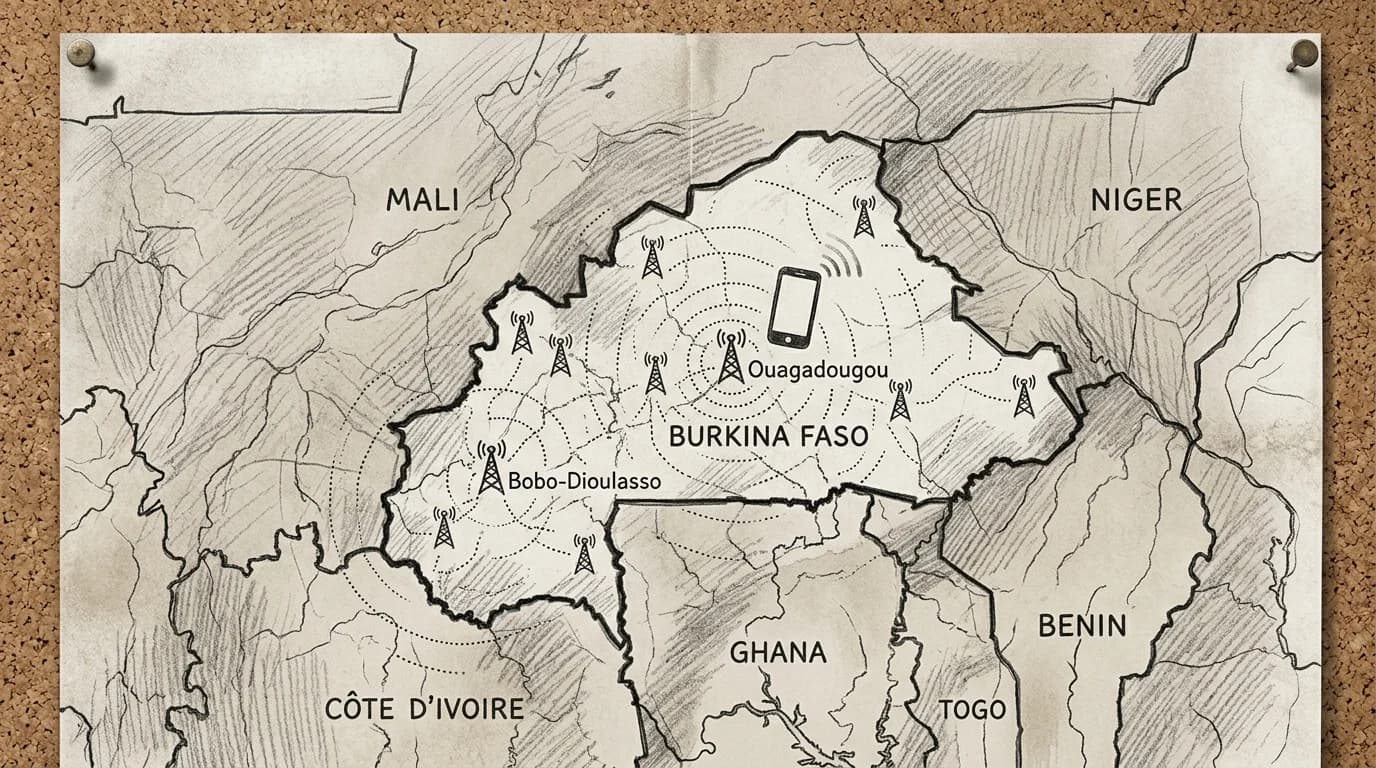
Network operators in Burkina Faso: Orange, Telecel, and what eSIMs actually route through
Two carriers run Burkina Faso's mobile network. Orange Burkina Faso holds the larger subscriber base and the stronger 4G LTE footprint; Telecel Faso (formerly Telmob, rebranded under the Telecel Group) operates the secondary grid. Most international eSIM providers that cover Burkina Faso route through Orange — its roaming agreements with global MVNO partners are broader, and you'll typically see "BF ORANGE" appear in your carrier field after activation.
4G LTE exists, but geography concentrates it hard. Ouagadougou's central arrondissements, the N1 corridor toward Bobo-Dioulasso, and a handful of regional capitals like Koudougou get usable LTE speeds. Outside those corridors, 3G is the realistic ceiling — and in northern and eastern prefectures near the Sahel belt, signal drops to EDGE or disappears entirely (GSMA Mobile Connectivity Index — Burkina Faso 2024).
Practical rule: If your itinerary runs beyond Ouagadougou into rural prefectures, plan for 3G data budgets — video calls and large downloads won't behave as they would in the capital.
Telecel's network fills some gaps Orange misses in the southwest, but no single carrier covers the full country reliably.
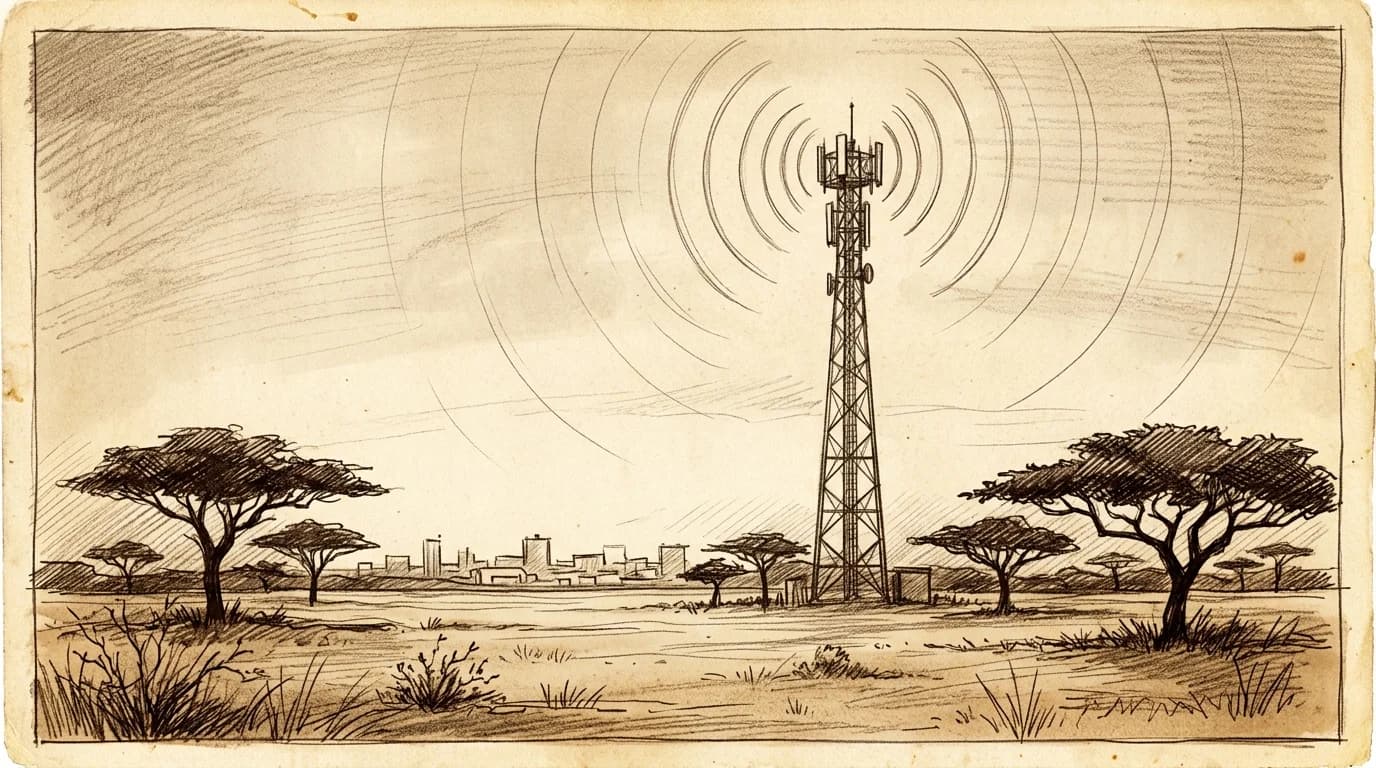
Practical rule: If your eSIM provider lists Orange Burkina Faso as the host MNO, expect genuine 4G LTE inside Ouagadougou and along the RN1 corridor to Bobo-Dioulasso — and 3G or worse everywhere else. Plan your bandwidth-heavy tasks (file uploads, satellite calls) for urban stops.
Choosing the right eSIM plan: regional Africa vs single-country
Single-country Burkina Faso plans are scarce in most eSIM catalogs — and the few that exist rarely cover border zones near Niangoloko or the Sahel corridors into Niger. A regional West Africa bundle solves that gap immediately.
For journalists rotating between Ouagadougou, Bamako, and Abidjan, a multi-country package is the practical default. Regional Africa bundles typically run $0.80–$1.40 per GB across a 30-day window, versus $2.50–$4.00 per GB on the thin inventory of single-country options — a cost difference that compounds fast on a two-week deployment with daily video uploads.
Practical rule: If your assignment crosses even one border — Burkina into Côte d'Ivoire, say — go regional from day one. Switching mid-trip wastes validity days and often requires a new QR scan on devices that only support one active data profile.
The exception is a short, Ouagadougou-only stay of seven days or fewer with no field movement. Single-country wins on simplicity there. For anything longer or more mobile, bookmark the top-up guide before you land — extended deployments almost always need a mid-trip data refresh.
Before you fly to Ouagadougou
- Confirm your phone is unlocked and eSIM-capable
- Buy your plan on home Wi-Fi before departure
- Download the eSIM profile and verify it appears in Settings
- Keep the eSIM toggled off until you clear customs
- Screenshot your QR code in case Wi-Fi drops mid-install
Practical rule: Choose a regional West Africa eSIM only if your assignment crosses into at least two other countries — Mali, Niger, or Côte d'Ivoire. For a Ouagadougou-only deployment under 21 days, a single-country 10 GB plan at roughly $18–22 will cost less and deliver better host-MNO priority than a diluted regional bundle.
How to activate your eSIM before you land in Ouagadougou
Ouagadougou International (Thomas Sankara) has public Wi-Fi, but counting on it to pull down a QR-code activation is a gamble you don't need to take. Do the whole install at home, over your regular broadband, before you touch the departure gate.
On iPhone, go to Settings > Cellular > Add eSIM, then either scan the QR code Roamfly emails you or tap "Enter Details Manually" if you have the activation code. Apple's own documentation walks through every screen (Apple Support — Use eSIM on iPhone). On Android, the path is Settings > Network & Internet > SIMs > Add eSIM — wording varies by manufacturer, but the flow is the same. Full screenshots for both are in the iPhone activation guide.
Install does not mean burning your data. The plan's clock starts when your device registers on a live Burkina Faso tower, not at download. Install at home, land in Ouagadougou, disable your physical SIM, and the eSIM picks up Orange or Telecel automatically.
Regional Africa eSIM vs single-country plan
| Factor | Regional Africa eSIM | Single-Country Burkina Faso |
|---|---|---|
| Coverage area | 30+ African countries | Burkina Faso only |
| Best for | Multi-stop itineraries | Single-destination trips |
| Network routing | Picks strongest available signal | Fixed to one local operator |
| Value at 7 days | (cost spreads across countries) | (data often unused) |
| Value at 30 days | (regional markup adds up) | (lower per-GB cost) |
Get connected before you leave
Your plan should be in your phone before your boarding pass is scanned. Burkina Faso has limited airport Wi-Fi, and the domestic SIM market in Ouagadougou moves slowly — queues at Orange counters in the arrivals hall can run 30 minutes on a busy day.
The setup takes under five minutes at your desk. Download the eSIM, leave it dormant, and it wakes the moment your phone sees a Burkinabè tower. No fumbling with a SIM pin over a baggage carousel. No roaming charges from your home carrier while you sort things out.
Traveling with a regional Africa plan adds flexibility if your itinerary touches Ghana, Senegal, or Côte d'Ivoire — one package covers the corridor instead of three separate purchases. Single-country coverage works if Burkina Faso is your only stop.
Ready to get connected? Roamfly's Burkina Faso eSIM ships in under 5 minutes.
Related guides
Ready to get connected? Roamfly's burkina eSIM ships in under 5 minutes.
Frequently asked questions
Which phones support eSIM for travel in Burkina Faso?
iPhones from XR (2018) onward, Google Pixel 4 and later, and Samsung Galaxy S20+ flagships all support eSIM. Check Settings → General → About → Available SIM on iPhone, or Settings → Connections → SIM Manager on Android. Burkina Faso's host networks broadcast standard LTE Band 3 and Band 7, which all eSIM-capable flagships support.
Does 4G LTE work outside Ouagadougou — in Bobo-Dioulasso or Dori?
4G LTE is reliable in Bobo-Dioulasso and along the RN1 highway corridor. Dori, near the Sahel border, drops to 3G HSPA in most neighborhoods and loses signal entirely in the surrounding bush. Orange Burkina Faso holds the widest rural footprint; Telecel coverage thins significantly north of Kaya.
Can I run an eSIM alongside a local Orange or Telecel SIM in dual-SIM mode?
Yes, on any dual-SIM device. Set your roaming eSIM as the data line and a locally purchased Orange or Telecel nano-SIM as the voice/SMS line — local calls run cheaper on a physical SIM, typically 50–100 CFA per minute versus international roaming rates. iPhone users: assign each line under Settings → Cellular → SIM Applications.
What happens if my eSIM data runs out mid-deployment in Burkina Faso with no Wi-Fi nearby?
Top up through the Roamfly app over any data connection — including a brief 2G edge from a borrowed phone or a hotspot. Top-ups apply within 60 seconds and extend validity without requiring a new QR scan or reinstall. If you're in a dead zone, the top-up queues and applies the moment your phone reacquires signal.
Is a regional West Africa eSIM plan cheaper than a Burkina Faso-specific plan for a multi-country trip?
Regional plans break even around the three-country mark. A Burkina Faso single-country plan typically covers 5–10 GB with a 30-day validity; a West Africa regional plan spanning Burkina Faso, Ghana, and Senegal costs roughly 20–30% more upfront but eliminates the need to buy and activate separate plans at each border. If your itinerary crosses four or more countries, the regional option almost always saves money.