Comparing eSIM free trial plans for travel in 2026 — what providers actually offer, what the fine print hides, and when a paid plan beats a free one.
"Free trial" does different work depending on who's using the term. Some providers hand you 100 MB or a 24-hour window — enough to verify your device connects, not enough to navigate from Charles de Gaulle to your hotel. Others label a $2 referral credit a "free trial" in their marketing, which is a discount, not a trial. The distinction matters before you plan a trip around it.
The most common genuine trial is a micro-data bundle: 100 MB to 500 MB, zero cost, valid for one or two days after first use. A handful of providers offer a 1-day unlimited tier as a promotional entry point — structurally similar to a paid 1-day plan (comparable packages run around $9.50 for unlimited daily access). That's a test drive, not a travel solution. Understanding what an eSIM actually is before comparing trial tiers saves real confusion later.
The GSMA's 2025 adoption report notes that consumer eSIM activations nearly doubled year-over-year (GSMA eSIM Adoption Report 2025), which has pushed more providers to use trial language as an acquisition tactic rather than a genuine product feature (GSMA eSIM Adoption Report 2025). Read the label carefully. "Free trial" and "free eSIM" are not the same offer.
How free trial plans compare to low-cost paid plans
Run the numbers once and the "free" label loses its shine fast. Most carrier free trials cap you at 200–500 MB and expire in 24–72 hours — enough for a airport transfer, not a three-day stint in Gjirokastër. A $4.50 Roamfly Albania plan gives you 1 GB over 3 days: roughly 5x the data for less than the price of a coffee at Tirana's Rinia Park.
| Provider type | Free data | Validity | Cost after trial |
|---|---|---|---|
| Carrier free trial | 200–500 MB | 24–72 hrs | $15–30 / GB |
| Roamfly Albania 1 GB | 1 GB | 3 days | $4.50 flat |
| Roamfly Albania 3 GB | 3 GB | 7 days | $10 flat |
Juniper Research's 2025 prepaid eSIM pricing analysis found that post-trial overage rates average 3–4x the per-GB cost of entry-level paid plans (Juniper Research prepaid eSIM pricing analysis 2025). The trial isn't really free — it's a preview that bills hard the moment you exceed it.
Practical rule: If your trip runs longer than 48 hours, skip the trial entirely and buy the smallest paid plan that covers your dates. For Albania, that's the 1 GB / 3-day plan at $4.50, detailed in Roamfly's Albania eSIM guide.
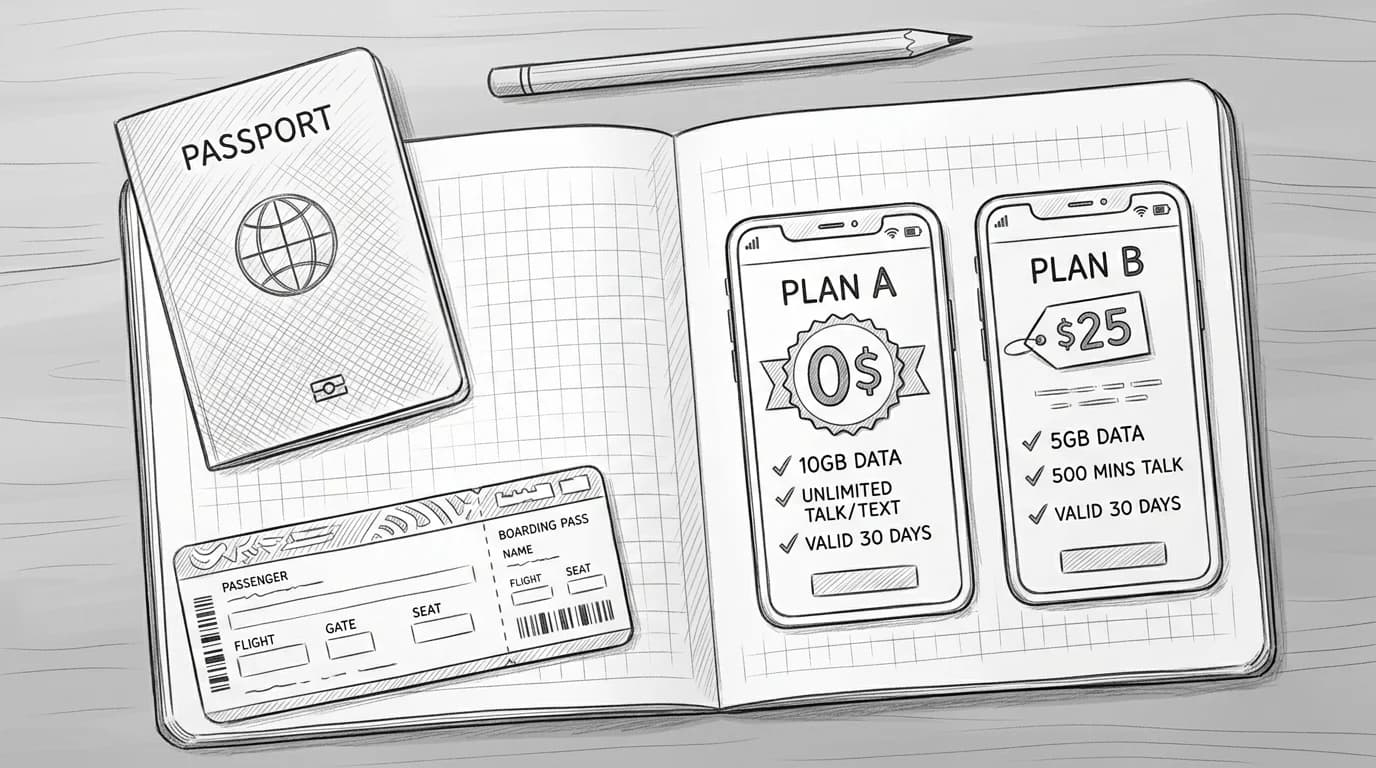
Practical rule: If your trip runs 3 days or more in a single country, skip the free trial math entirely. A 1 GB / 3-day Albania plan at $4.50 gives you full-speed data from minute one — a 100 MB throttled trial runs out before you clear passport control.
The fine print that shrinks every free trial
Four restrictions show up constantly, and providers bury all of them.
Device locks come first. Most trial offers require an iPhone XS or later, or an Android flagged as eSIM-capable after 2020 — older Pixel 3a units and budget Androids are frequently excluded. Check how eSIM works on iPhone and Android before assuming your handset qualifies.
Single-region activation is the second catch. A "Europe trial" that locks on first connection in Paris won't extend to Barcelona, even if the marketing said otherwise.
Speed throttling hits hardest. Many trials advertise 1 GB but cap speeds to 512 kbps the moment you cross a much lower internal floor — sometimes 200 MB — making video calls useless for the remaining data.
Practical rule: Read the validity trigger, not just the validity length. A 7-day trial that starts on install at 11 PM Sunday expires before the following Sunday morning — you lose a full calendar day before you've boarded.
The expiry-on-install problem is the least visible and the most damaging. Install Thursday night for a Friday flight, and your countdown is already running.
Free Trial vs Low-Cost Paid eSIM
| Factor | Free Trial eSIM | Low-Cost Paid Plan |
|---|---|---|
| Upfront cost | typically under $5 | |
| Data included | 100 MB–500 MB typical | 1 GB–5 GB typical |
| Validity window | 24–72 hours, often shorter | 7–30 days |
| Top-up option | in-app | |
| Usable for full trip |
Practical rule: Check whether the trial validity clock starts on install or first use. Most free trials begin the moment the eSIM profile downloads — not when you land — so installing 48 hours before departure can silently consume half your window before your flight boards.
When a free trial is worth using — and when to skip it
A 6-hour layover at Charles de Gaulle — specifically bouncing between Terminal 2E and the satellite — is exactly where a free trial earns its keep. You need maps, a boarding pass refresh, maybe a Uber to a nearby hotel. That's 200 MB, not 5 GB. Burning a free trial there instead of paying $54 for a 50 GB / 30-day France plan is the right call.
The math flips the moment your trip stretches past two or three days in one country. A paid 3 GB / 7-day Albania plan runs $10 — that's $3.33 per GB with a full week of validity; a free trial offering 1 GB for three days at no cost sounds better until you hit the cap on day two and need to top up anyway.
The other legitimate use case: vetting a new provider before committing to a multi-week plan. Run a free trial on a short domestic leg, check speeds, confirm activation works on your handset, then buy the longer plan with confidence. Business travelers juggling a rolling itinerary across six countries can read more in Roamfly's guide to eSIM for business travelers — the provider-testing logic applies directly there.
Skip the free trial if your trip exceeds 72 hours in a single destination, or if the paid equivalent costs less than $5. At that price point, the free option saves you nothing except the checkout step.
Before claiming a free trial plan
- Confirm data cap covers your arrival day only
- Check validity clock starts on activation, not purchase
- Verify the plan covers your destination country
- Read whether tethering is blocked on trial tier
- Have a paid backup plan ready before you fly
Get connected before you leave
The math is straightforward. Albania for a long weekend: 1 GB over 3 days costs $4.50. France for a month: 50 GB over 30 days runs $54. Neither requires a trial period, a carrier account, or a terms-of-service scroll that buries the data cap on page four.
Paid short-validity plans exist precisely for the window where free trials feel tempting — sub-week trips where you want certainty without commitment. The Albania plan activates in under five minutes; the France plan covers a month of heavy navigation, streaming, and video calls without throttling anxiety. Both are live the moment you land, not after a 24-hour "verification window" that eats your first day.
Before you travel, check how to activate an eSIM on iPhone before your trip — front-loading setup at home means you clear customs connected, not hunting for airport Wi-Fi.
Ready to get connected? Browse Roamfly's full eSIM catalog — plans start at $4.50 and ship in under 5 minutes.
Frequently asked questions
Do any major eSIM providers offer a genuine free trial in 2026?
A handful do — Airalo's 'Try eSIM' promo and Holafly's periodic free-day offers are the most cited — but coverage is narrow (usually one region) and data caps sit at 100–500 MB. Most 'free' tiers are marketing funnels tied to app downloads or account creation, not unconditional trials.
How much data does a typical eSIM free trial include?
Most free trial plans cap out at 100–500 MB and expire within 24–72 hours of first use. That covers roughly 30–40 minutes of Google Maps navigation or about 200 emails with attachments — enough for airport transit, not a full travel day.
Is a $4–5 paid short-term plan better value than a free eSIM trial?
In most cases, yes. A $4.50 Roamfly 1 GB / 7-day plan for Southeast Asia delivers 10–20x more data than a typical free trial, with no app-install requirement and coverage across multiple countries. The free trial math only works if you need connectivity for under two hours in a single city.
Do free eSIM trials work the same on iPhone and Android?
Activation works identically — scan the QR in Settings on either platform — but iPhone 14 and earlier models only support one active eSIM at a time in some regions (Apple Support — Use dual SIM with an eSIM), which means installing a trial eSIM may temporarily disable your home plan. Pixel 7 and Galaxy S24 handle dual active eSIMs without that conflict.
What happens if a free trial eSIM expires while I'm still traveling?
The eSIM profile stays installed on your phone but stops routing data. You won't get a warning mid-session — the connection simply drops. To restore connectivity you'll need to purchase a paid plan or top up, which on most platforms takes under five minutes through the provider's app.